Product Line | Kluwer Law International |
|---|---|
Product SKU | 10059614-0001 |
ISBN-13 | 9789041146632 |
Availability | Ships in 3-5 Business Days |
Last Updated | 2013-01-25 |
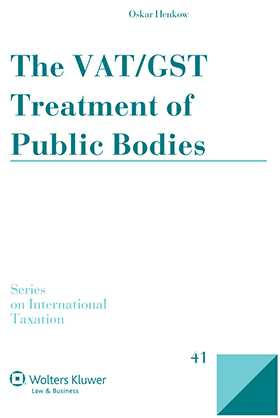
Most VAT systems exclude public bodies from the scope of value added tax (VAT) systems. However, a movement to include public sector bodies within the GST system to some extent or even fully (as in New Zealand) is gaining momentum, and underlies the European Commission’s 2011 study on the treatment and economic impact of exemptions in the public interest. Whether the present EU treatment really is as bad as some of its critics suggest, and whether the New Zealand model really is so perfect that jurisdictions with exclusion models ought simply to replace these existing systems with a New Zealand style system: these are the questions which triggered this research and which form the basis for the critical analysis contained in this book.
Using a system design point of view, the author focuses on VAT systems where exclusion or inclusion of public bodies are currently being applied and on how these models function. He presents an in-depth analysis of the major issues in this context, such as the treatment of public bodies as taxable persons, their right to deduct input VAT on acquisitions, and the treatment of the income of public bodies. Specific aspects examined include the following:
Chapter 1 VAT/GST and the Public Sector: Issues and Problems.
Part II Exclusion Systems.
Chapter 2 The Exclusion of Public Bodies from the Scope of European VAT .
Chapter 3 The Treatment of the Income of a Public Body.
Chapter 4 Deduction of Input VAT and Other Issues.
Chapter 5 VAT Compensation Schemes in Denmark.
Chapter 6 VAT Compensation Schemes in Sweden.
Chapter 7 Other VAT Compensation Schemes.
Chapter 8 State Aid and Compensation Schemes.
Chapter 9 Concluding Discussion.
Part III Full Taxation Models.
Chapter 10 New Zealand’s GST System and Public Management.
Chapter 11 The Inclusion of Public Bodies in New Zealand.
Chapter 12 The Treatment of the Income of Public Bodies.
Chapter 13 Other Issues and Conclusions.
Part IV Evaluation.
Chapter 15 Towards a ‘Best Practice’.
Bibliography.
Official Legal References.
Table of Cases.
Index.
 NEED HELP FINDING THE RIGHT SOLUTION?
Call sales at 1-800-638-8437
 HAVE A QUESTION?


These cookies are necessary for the website to function. They are usually set in response to actions made by you which amount to a request for services, such as setting your privacy preferences, logging in or filling in forms. You can set your browser to block or alert you about these cookies, this may have an effect on the proper functioning of (parts of) the site.
These cookies enable the website to provide enhanced functionality, user experience and personalization, and may be set by us or by third party providers whose services we have added to our pages. If you do not allow these cookies, then some or all of these services may not function properly.
These cookies support analytic services that measure and improve the performance of our site. They help us know which pages are the most and least popular and see how visitors move around the site.
These cookies may collect insights to issue personalized content and advertising on our own and other websites, and may be set through our site by third party providers. If you do not allow these cookies, you may still see basic advertising on your browser that is generic and not based on your interests.
