Product Line | Wolters Kluwer Legal & Regulatory U.S. |
|---|---|
Product SKU | 10045385-7777 |
Availability | Ships in 3-5 Business Days |
Last Updated | 2017-02-23 |
As fracking has become the most significant environmental law and public policy question of the 21st Century, its impact has spread out to touch numerous disciplines and many areas of law.
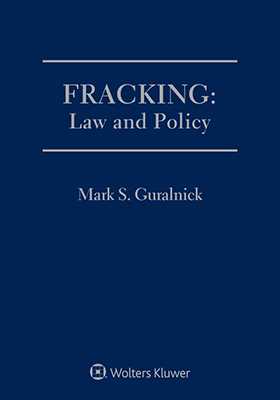
Fracking: Law and Policy is the single-source reference that addresses all the law and public policy issues relating to fracking.
Written by, Mark S. Guralnick, this multi-purpose deskbook addresses the current law and public policy issues related to fracking. It also serves as a formbook, practice manual, and reference guide covering all key areas of fracking, including the law, environmental, business, and public policy arenas. Jurisdiction, regulation, litigation, mineral rights and royalties, banking and insurance issues, worker safety and injury claims, insurance coverage, environmental and public health controversies, activism, and more, are all covered.
Regarding the law, Fracking: Law and Policy delivers clear, plain-English discussions of:
Fracking: Law and Policy also closely examines the litigation landscape, with:
In addition, an entire portion of Fracking: Law and Policy is dedicated to public policy, sustainable business and corporate social responsibility, delivering valuable chapters on:
Fracking: Law and Policy takes an objective look at organized activism, the need for engagement, and the risks associated with extremism and misinformation. A list of activist groups is provided.
The book also tackles each of the major environmental and public health controversies:
Fracking: Law and Policy provides the most comprehensive and meticulous examination of all scientific, regulatory, economic, cultural, social, legal, and policy issues connected to this highly charged topic. It is the ideal resource for lawyers, regulators, scientists, engineers and oil and gas contractors, insurers, investors, safety inspectors, citizen advocates, legislators, policymakers, energy professionals and financial advisors.
PART I - THE BACKDROP
Chapter 1. SCOPE
Chapter 2. THE SCIENCE OF FRACKING
Chapter 3. JURISDICTION
Chapter 4. FEDERAL STATUTORY FRAMEWORK
Chapter 5. REGULATORY INFRASTRUCTURE
Chapter 6. THE FRACKING FRONTIER
Chapter 7. THE ECONOMICS OF FRACKING
PART II - THE LITIGATION LANDSCAPE
Chapter 8. THEORIES OF LIABILITY
Chapter 9. INITIAL PLEADINGS AND PROCEDURES
Chapter 10. PRETRIAL DISCOVERY AND INVESTIGATION
Chapter 11. THE FRACKING TRIAL
Chapter 12. DAMAGES AND REMEDIES
Chapter 13. WORKER SAFETY AND INJURY CLAIMS
PART III - PUBLIC POLICY, SUSTAINABLE BUSINESS, AND CORPORATE SOCIAL RESPONSIBILITY
Chapter 14. MINERAL LEASING LAW AND POLICY
Chapter 15. INDUSTRY REPORTING ISSUES
Chapter 16. CORPORATE RISK MANAGEMENT AND BEST PRACTICES
Chapter 17. SHAREHOLDER AND STAKEHOLDER PROTECTION
Chapter 18. INSURANCE AND RISK
Chapter 19. OPTIMIZING CITIZEN ACTIVISM
Chapter 20. PUBLIC POLICY
Glossary
Table of Cases
Table of Statutes and Regulations
Index
 NEED HELP FINDING THE RIGHT SOLUTION?
Call sales at 1-800-638-8437
HAVE A QUESTION?


These cookies are necessary for the website to function. They are usually set in response to actions made by you which amount to a request for services, such as setting your privacy preferences, logging in or filling in forms. You can set your browser to block or alert you about these cookies, this may have an effect on the proper functioning of (parts of) the site.
These cookies enable the website to provide enhanced functionality, user experience and personalization, and may be set by us or by third party providers whose services we have added to our pages. If you do not allow these cookies, then some or all of these services may not function properly.
These cookies support analytic services that measure and improve the performance of our site. They help us know which pages are the most and least popular and see how visitors move around the site.
These cookies may collect insights to issue personalized content and advertising on our own and other websites, and may be set through our site by third party providers. If you do not allow these cookies, you may still see basic advertising on your browser that is generic and not based on your interests.
