Product Line | Kluwer Law International |
|---|---|
ISBN-13 | 9789403503370 |
Availability | Ships in 5-7 Business Days |
Last Updated | 2023-05-15 |
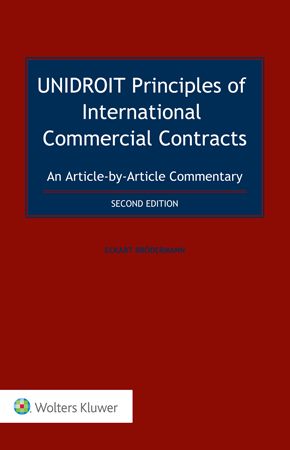
The Unidroit Principles of International Commercial Contracts provide an excellent and practice proven tool for cross-border contracts:
Thirty years after their first publication, it is arguably malpractice to ignore them.
In this fully revised and enlarged 2nd edition, the commentary continues to analyse the Unidroit Principles article by article from a practical perspective, while always discussing alternative courses of action, where they apply. The commentary includes proposals for choice of the Unidroit Principles’ clauses and practical guidance for their use as template, or to supplement the CISG or national law. In addition to arbitral and state court decisions and recent literature, the 2nd edition includes an in-depth analysis of extensive legislative material.
The author is a German practitioner with international training and familiarity with both common and civil law. He has been admitted to the New York Bar and also teaches at the University of Hamburg as a Professor of Law. The author is using the Unidroit Principles for more than 20 years in his commercial and arbitration practice, in recent years on a daily basis in multiple industries. As he shares his experience under the Unidroit Principles, the commentary can also be used as a practical guide and checklist of issues to consider in international contracting.
Sample from page 340, no. 6, on Article 7.1.3 (Withholding performance), at C. Options
In long-term contracts (e.g. on parts for serial production), sometimes both parties blame each other and rely on mutual withholding rights. Example: Disagreement on the root cause of and responsibility for certain allegedly defective parts, delivered under a long-term contract on the production of parts for the automotive industry, when it is not (yet) clear whether the parts delivered by the seller were defective, or whether the defect was caused through the combination of the parts with a system environment at the level of the buyer. The buyer withholds payment because of (alleged) claims for damages and the seller withholds further deliveries subject to payment (of the ‘ok parts’ from its perspective). To avoid exploding risks of damages (e.g. through a stand-still of production at the buyer’s or its customer’s production line and subsequent expensive arbitration), it can help to negotiate the following option: that (i) the buyer pays the open invoices; (ii) the seller places a security (e.g. a bank guarantee) for the alleged claim; and (iii) the parties agree to continue performance of the long-term contract and cooperate in the root cause analysis which shall reveal which party is right.
Example from practice (in 2022) where the parties (who acted under old contracts – governed by the CISG as the national law of the seller – when the problems occurred) agreed along these lines in an ‘Interim Agreement’ under the Unidroit Principles and later transferred this solution to a ‘Framework Agreement’, also negotiated under the Unidroit Principles (automotive industry).
FOREWORD TO THE 2nd EDITION BY THE AUTHOR
PREFACE TO THE 1st EDITION 2018 BY THE CHAIRMAN OF THE WORKING GROUP
THANK YOU
ABBREVIATIONS
DEFINITIONS IN THE Unidroit PRINCIPLES
GLOSSARY OF LATIN TERMS
GLOSSARY OF FRENCH TERMS
RELEVANT SUPPLEMENTARY SOFT LAW & DOCUMENTS
MATERIALS: Preparatory work of Unidroit (Legislative History)
BIBLIOGRAPHY
RELEVANT WEBSITES
WORKING GROUPS
Unidroit PRINCIPLES OF INTERNATIONAL COMMERCIAL CONTRACTS 2016
TABLE OF CORRESPONDENCE OF THE ARTICLES OF THE 1994, 2004, 2010 and 2016 EDITIONS OF THE Unidroit PRINCIPLES
Introduction to the Unidroit Principles of International Commercial Contracts (“PICC”)
Preamble (Purpose of the Principles)
Annex to Preamble — Unidroit Principles as General Principles of International Commercial Contract Law
Chapter 1 General Provisions
Chapter 2 Formation and Authority of Agents
Chapter 3 Validity
Chapter 4 Interpretation
Chapter 5 Content, Third Party Rights and Conditions
Chapter 6 Performance
Chapter 7 Non-performance
Chapter 8 Set-off
Chapter 9 Assignment of Rights, Transfer of Obligations, Assignment of Contracts
Chapter 10 Limitation Periods
Chapter 11 Plurality of Obligors and of Obligees
INDEX
The book follows the scholarly writing style of civil law but makes ample references to historical materials, case law, and alternative interpretations of the 211 articles contained in UPICC. The book is written from a practical perspective, it serves as a valuable guidance for academicians and legislators. The most striking feature is the meticulous attention paid to the comparative analysis between common law and civil law. The new chapter on “Specific Kinds of Contracts” in the form of a checklist is particularly useful for anyone engaged in cross-border transactions related to sales, services, and construction contracts, especially long-term contract, which addresses key concerns of quality, delay, passing of risk, risk management and other vital areas.
Anyone connected to international trade and commercial contracts must read and have the book in their library.— Prof. (Dr.) Ajar Rab, Indian Journal of Arbitration Law. Volume 13, issue 1
Professor E. Brödermann’ s commentary can serve as a practical and academic tool for working with the Unidroit Principles that no lawyer or arbitrator acting internationally should ignore 30 years after their first publication. In the same vein, the commentary can also be used as teaching material on contract law in universities to offer a global and comparative perspective when teaching national contract law. Whether used for one purpose or another, the intelligent reader will appreciate that he has a masterpiece in his hands.—Calvo Caravaca, Alfonso L. Revista Argentina de Arbitraje, issue 14 2025 (Translated from Spanish)
 NEED HELP FINDING THE RIGHT SOLUTION?
Call sales at 1-800-638-8437
HAVE A QUESTION?


These cookies are necessary for the website to function. They are usually set in response to actions made by you which amount to a request for services, such as setting your privacy preferences, logging in or filling in forms. You can set your browser to block or alert you about these cookies, this may have an effect on the proper functioning of (parts of) the site.
These cookies enable the website to provide enhanced functionality, user experience and personalization, and may be set by us or by third party providers whose services we have added to our pages. If you do not allow these cookies, then some or all of these services may not function properly.
These cookies support analytic services that measure and improve the performance of our site. They help us know which pages are the most and least popular and see how visitors move around the site.
These cookies may collect insights to issue personalized content and advertising on our own and other websites, and may be set through our site by third party providers. If you do not allow these cookies, you may still see basic advertising on your browser that is generic and not based on your interests.
