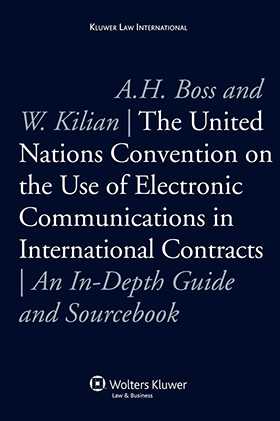
Product Line | Kluwer Law International |
|---|---|
Product SKU | 10058712-0001 |
ISBN-13 | 9789041127495 |
Availability | Ships in 3-5 Business Days |
Last Updated | 2008-12-19 |
The use of electronic commerce in international trade is growing by leaps and bounds. No one can dispute the need for a system of rules to guide countries as well as private commercial parties through the many new developments and issues that arise. The United Nations Convention on the Use of Electronic Communications in International Contracts (ECC), adopted by the United Nations General Assembly in December 2005 and currently undergoing the ratification process, provides such a system. This book is a guide and resource on the Convention: its evolution, interpretation, and relationship to domestic laws throughout the world.
The book represents the outcome of a conference held at the Leibniz University of Hannover in September 2007. It consists of an introduction to the drafting of the Convention, expert commentary on each article, and perspectives in the context of domestic and substantive law. A distinguished panel of authorities- representatives of governments, international organizations, transnational companies, and universities, as well as practising attorneys, all of whom have been active domestically and internationally in confronting the legal issues of electronic commerce- discuss such aspects of the ECC as the following:
Several authors provide in-depth analysis of the interaction between ECC provisions and other relevant legal regimes (including the United States, ASEAN, the EU, Sri Lanka, India, and China), as well as the interrelations between the ECC and ICC rules, rules under the CISG, and the trade usages of the lex mercatoria.
The various contributors highlight issues arising from each ECC provision, and provide well-informed insight into how remaining problems are likely to be resolved as the Convention enters into force. Stakeholders from all concerned sectors of the legal community - businesspersons and their counsel, IGO and government officials, and academics - will benefit greatly from the detailed information, analysis, and guidance offered here.
List of Contributors. Foreword. Preface. Acknowledgements. Introduction;
A.H. Boss.
Part I. Drafting and Negotiating History of the Electronic
Communications Convention; J.A. Estrella-Faria.
Part II. 1. Sphere of Application; A.H. Boss.
2. General Provisions; R. Sandoval López, E. Özsunay.
3. Use of Electronic Communications in International Contracts; G.
Fuping, T. Smedinghoff, W.Kilian, E. Özsunay, J. Gregory, J. Remsu.
4. Final Provisions; S. Eiselen, J. Remsu, J. Gregory, C. Connolly, C.
Kuner.
Part
III. 1. United States Perspective on the Convention on the Use of
Electronic Communications in International Contracts; A.H. Boss. 2.
Using the Electronic Communications Convention to Harmonize National and
International Electronic Commerce Laws: An ASEAN Case Study; C. Connolly
. 3. The Interaction between the Electronic Communications Convention
and the United Nations Convention on the International Sale of Goods; S.
Eiselen. 4. A Developing Country Perspective: The Impact of the
Electronic Communications Convention on Legislation in the South Asian Region;
J. Fernando. 5. Implementation of the Electronic Communications
Convention: A Chinese Perspective; F. Gao. 6. The Electronic
Communications Convention: A European Union Perspective; W. Kilian.
7. ICC Perspectives on the United Nations Electronic Communications
Convention; C. Kuner. 8. Trade Usages under the Electronic
Communications Convention; P. Polański. 9. The Role of
Information Security in the Electronic Communications Convention; T.
Smedinghoff. Appendices: A. United Nations Convention on the Use of
Electronic Communications in International Contracts. B. List of
Signatories to the Electronic Communications Convention. C. Electronic
Communications Convention travaux préparatoires. D. List of
Participants in the Drafting of the Electronic Communications Convention. E.
UNCITRAL Model Law on Electronic Commerce (1996). F. Domestic
Enactments of the UNCITRAL Model Law on Electronic Commerce. G.
Glossary of Frequently Used Terms and Abbreviations. Bibliography. Index.
 NEED HELP FINDING THE RIGHT SOLUTION?
Call sales at 1-800-638-8437
HAVE A QUESTION?


These cookies are necessary for the website to function. They are usually set in response to actions made by you which amount to a request for services, such as setting your privacy preferences, logging in or filling in forms. You can set your browser to block or alert you about these cookies, this may have an effect on the proper functioning of (parts of) the site.
These cookies enable the website to provide enhanced functionality, user experience and personalization, and may be set by us or by third party providers whose services we have added to our pages. If you do not allow these cookies, then some or all of these services may not function properly.
These cookies support analytic services that measure and improve the performance of our site. They help us know which pages are the most and least popular and see how visitors move around the site.
These cookies may collect insights to issue personalized content and advertising on our own and other websites, and may be set through our site by third party providers. If you do not allow these cookies, you may still see basic advertising on your browser that is generic and not based on your interests.
