Product Line | Kluwer Law International |
|---|---|
Product SKU | 10058668-0001 |
ISBN-13 | 9789041123954 |
Availability | Ships in 3-5 Business Days |
Last Updated | 2005-09-07 |
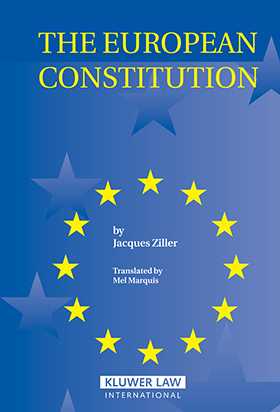
This remarkable book offers a first in-depth analysis of the Treaty establishing a Constitution for Europe. As the author constitutional law expert Jacques Ziller notes, the new Constitution is in many ways a grand integration of elements from existing European law (most importantly from the case law of the European Court of Justice), yet at the same time the new text features groundbreaking innovations with far-reaching implications for the future of Europe.
Combining legislative history, acute insight, rigorous analysis, and detailed supplementary information, The European Constitution elucidates the genesis, growth, and future implications of the EU's constitutional development. Professor Ziller's treatment examines and illuminates the following subjects, among others:
As one of the book's most extraordinary features, the commentary is regularly accompanied by tables illustrating essential terms and concepts pertinent to the discussion. A first publication of the book in France and Italy just after the end of the Convention's work proved such a success that a second edition was requested as soon as the final text of the Treaty was approved. The fate of the Constitution will be determined by the vagaries of the ratification process. Yet whatever the outcome, Professor Ziller has rendered an indispensable service, as the principles and arguments crystallised in this moment of Europe's political history will continue to exercise a profound effect on its future development. And while the breadth and precision of the knowledge embodied in this work is prodigious, the presentation is clear, simple, and captivating. It is sure to be useful to anyone interested in the new European Constitution the uninitiated and the seasoned veteran alike.
Jacques Ziller is a Professor of Law at the European University Institute in Florence, Italy, on leave from the University Paris I Panthéon-Sorbonne. He has authored numerous books and articles concerning various aspects of European Union law, as well as many other legal topics, and has taught at several major universities and training institutions in France, Belgium, Spain and The Netherlands. He is fluent in French, English, German, Dutch, Italian and Spanish. During the European Conventions work, Professor Ziller served as Counsel to the EU Committee of the Regions and thus brings an insider's perspective to the evaluation of its work.
Preface; G. Amato. Note regarding citations. I. Why have a Constitution? 1. What has changed? A Constitution in the tradition of the Enlightenment. 2. What hasn't changed? A Constitution without a State. 3. Imparfaite, mais inespérée. II. The European Constitution: What is it, exactly? 1. A Treaty laying the foundations of a Constitution. 2. One text instead of two. 3. Four Parts distinguished according to their content, origins and elaboration. 4. One text; at least twenty-one languages. III. The European Convention: A Constitution is born. 1. From a body to a diverging visions and interests. 2. The Laeken mandate: The Convention on the future of Europe. 3. A melting pot of diverging visions and interests. 4. The members of the Convention. 5. Neither a parliament nor a conference of diplomats. 6. The IGC: A few steps forward, a few steps to the rear. IV. What everybody thinks they know 1. but what only the future can say. 2. what may be surmised 3. Less simple than it seems. V. The road ahead. 1. Enlargement: Is the Constitution suitable for a Europe of 25 Member States? 2. Ratification and entry into force. Related reading.
 NEED HELP FINDING THE RIGHT SOLUTION?
Call sales at 1-800-638-8437
HAVE A QUESTION?


These cookies are necessary for the website to function. They are usually set in response to actions made by you which amount to a request for services, such as setting your privacy preferences, logging in or filling in forms. You can set your browser to block or alert you about these cookies, this may have an effect on the proper functioning of (parts of) the site.
These cookies enable the website to provide enhanced functionality, user experience and personalization, and may be set by us or by third party providers whose services we have added to our pages. If you do not allow these cookies, then some or all of these services may not function properly.
These cookies support analytic services that measure and improve the performance of our site. They help us know which pages are the most and least popular and see how visitors move around the site.
These cookies may collect insights to issue personalized content and advertising on our own and other websites, and may be set through our site by third party providers. If you do not allow these cookies, you may still see basic advertising on your browser that is generic and not based on your interests.
