Product Line | Kluwer Law International |
|---|---|
Product SKU | 10059540-0001 |
ISBN-13 | 9789041131539 |
Availability | Ships in 3-5 Business Days |
Last Updated | 2009-08-24 |
Energy and Environmental Law and Policy Series
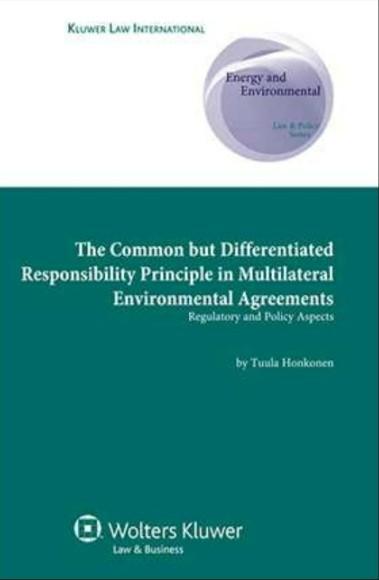
Built in to every multilateral environmental agreement is a dilemma: how to incorporate justice and fairness on the one hand and effectiveness on the other. Our immense difficulty in meeting this two-edged imperative highlights the fact that we are, at best, at an early stage in the development of international environmental ethics, and that no coherent and effective ethical system yet exists in this context. This remarkable book starts from a conviction that the principle of common but differentiated responsibility (CBDR) offers the best way forward toward the much-desired goal of sustainable development.
Presenting a full-scale, multidisciplinary assessment of the feasibility of the principle of CBDR in multilateral environmental agreements, encompassing legal and policy status perspectives as well as historical developments and future prospects, this study identifies issues and aspects in the theoretical and practical application of the CBDR principle. The author responds with in-depth knowledge and awareness to such specific questions as the following:
The author examines methods for differentiation from both theoretical and actual treaty-level viewpoints. She offers examples from the negotiation history of international environmental treaties to shed light on the importance of information-sharing and wide participation during the negotiations. Recognizing that, in the international environmental field, problems of economic development and the geopolitics of global wealth distribution soon come to the fore, and that each state’s right to development should not be too heavily restricted under international environmental regimes, she demonstrates that the CBDR principle has a strong potential to formally integrate the environment and development at the international level.
The study will be of immeasurable value in promoting understanding of how CBDR actually works. It will help lawyers and policymakers perceive how different parties want to use the principle, and to discern clearly what options could be chosen by the parties, which aspects are crucial, and what factors influence the effectiveness of the arrangements.
Preface
Abbreviations
1. Introduction
2. Background for and Development of CBDR
3. Operationalization of CBDR in Multilateral Environmental Agreements
4. CBDR: A Regulatory and Regime Management Analysis
5. Status and Future Prospects of the Principle of CBDR
6. Completing and Concluding Remarks. Bibliography
Table of Treaties
Other International Legal Documents
International Soft Law Documents
Table of Cases
Index.
 NEED HELP FINDING THE RIGHT SOLUTION?
Call sales at 1-800-638-8437
HAVE A QUESTION?


These cookies are necessary for the website to function. They are usually set in response to actions made by you which amount to a request for services, such as setting your privacy preferences, logging in or filling in forms. You can set your browser to block or alert you about these cookies, this may have an effect on the proper functioning of (parts of) the site.
These cookies enable the website to provide enhanced functionality, user experience and personalization, and may be set by us or by third party providers whose services we have added to our pages. If you do not allow these cookies, then some or all of these services may not function properly.
These cookies support analytic services that measure and improve the performance of our site. They help us know which pages are the most and least popular and see how visitors move around the site.
These cookies may collect insights to issue personalized content and advertising on our own and other websites, and may be set through our site by third party providers. If you do not allow these cookies, you may still see basic advertising on your browser that is generic and not based on your interests.
