Product Line | Kluwer Law International |
|---|---|
ISBN-13 | 9789403556406 |
Availability | This product is available for pre-sale |
Last Updated | 2026-10-31 |
International Arbitration Law Library Series Volume #83
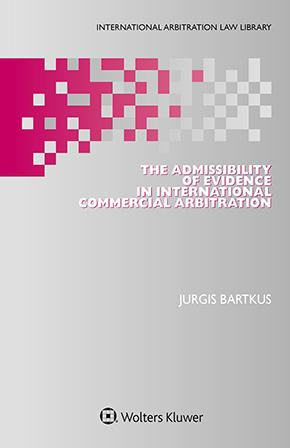
The Admissibility of Evidence in International Commercial Arbitration is an innovative book that provides a penetrating analysis of the underlying function and purpose of admissibility rules and guides practitioners to more predictable and better-reasoned decisions on whether to admit or exclude evidence in international commercial arbitration (ICA) proceedings and how such evidence should be treated. In ICA practice, the rules on admissibility of evidence are often framed not as fixed legal rules but as discretion-conferring provisions (the so-called liberal approach) – a stratagem which tends to generate legal uncertainty, contradictory case law, subjective decision making, and inefficiency.
What’s in this book:
Drawing on the principal sources governing the taking of evidence in arbitration – including the UNCITRAL Model Law, institutional arbitration rules, the IBA Rules on the Taking of Evidence, and the New York Convention – the author assesses the whole status quo of admissibility of evidence in ICA, focusing on such aspects as the following:
The analysis clearly shows how the ‘liberal’ approach has prevented a clear understanding both of specific rules on the admissibility of evidence set out in the sources and of the importance of these rules in arbitration proceedings. Accordingly, the author puts forward concrete reform proposals, centred on amending a soft law instrument through balancing tests built on an exhaustive, predetermined list of criteria, which would curb the problems of discretion while preserving the flexibility of arbitration.
How this will help you:
The book serves a broad professional readership – arbitrators, arbitration counsel, in-house lawyers, arbitral institutions, and academics – by bridging the gap between evidence theory and arbitral practice. It will equip arbitrators and counsel to frame and respond to admissibility objections with greater rigour, help arbitration users plan their evidentiary strategy, and offer scholars and law reformers a critical framework and concrete proposals for improving the legal certainty, consistency, and efficiency of evidentiary decision making in arbitration.
About the Author
Abstract for the Book
List of Abbreviations
Preface
Acknowledgements
CHAPTER 1
The Conceptual and Purposive Approaches Towards the Admissibility of Evidence in International Commercial Arbitration
CHAPTER 2
The Exercise of Discretion in Determining the Admissibility of Evidence in International Commercial Arbitration
CHAPTER 3
Changes to the Status Quo of Admissibility of Evidence in International Commercial Arbitration
Bibliography
Table of Cases
Table of Legislation and Other Legal Instruments
 NEED HELP FINDING THE RIGHT SOLUTION?
Call sales at 1-800-638-8437
HAVE A QUESTION?


These cookies are necessary for the website to function. They are usually set in response to actions made by you which amount to a request for services, such as setting your privacy preferences, logging in or filling in forms. You can set your browser to block or alert you about these cookies, this may have an effect on the proper functioning of (parts of) the site.
These cookies enable the website to provide enhanced functionality, user experience and personalization, and may be set by us or by third party providers whose services we have added to our pages. If you do not allow these cookies, then some or all of these services may not function properly.
These cookies support analytic services that measure and improve the performance of our site. They help us know which pages are the most and least popular and see how visitors move around the site.
These cookies may collect insights to issue personalized content and advertising on our own and other websites, and may be set through our site by third party providers. If you do not allow these cookies, you may still see basic advertising on your browser that is generic and not based on your interests.
