Product Line | Kluwer Law International |
|---|---|
ISBN-13 | 9789403537986 |
Availability | Ships in 5-7 Business Days |
Last Updated | 2026-04-28 |
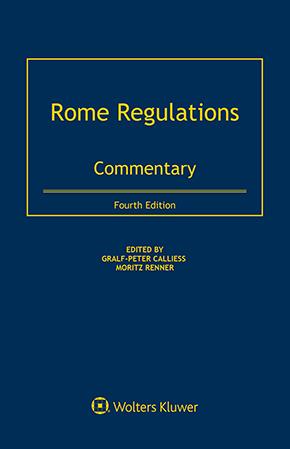
Rome Regulations is an article-by-article ‘German-style’ commentary on the Rome I, II and III Regulations on European Union (EU) conflict of laws. It describes and explains black letter law as represented by the jurisprudence of the Court of Justice of the EU (CJEU) and the Member State courts. The law applicable to contractual and non-contractual obligations in cross-border civil and commercial matters in the EU is the remit of the so-called Rome I and II Regulations that entered into force in 2009, supplemented by the Rome III Regulation of 2012, dealing specifically with divorce and legal separation. The fourth edition reflects significant developments since 2020, including landmark CJEU decisions advancing a common European understanding of the Regulations' central provisions, the post-Brexit landscape of EU-UK relations in private international law, and the increasing intersection of economic sanctions with conflict of laws principles. The commentary has been recognized as a leading authority by the EU and national courts alike.
What’s in this book:
The commentary, authored by leading scholars of conflict of laws for an international readership and drawing on a wide spectrum of case law and scholarship, highlights contemporary developments and long-term implications of the Rome Regulations, such as the following:
This edition is a cornerstone resource in handling European cases involving questions of conflict of laws.
How this will help you:
In the current era of globalization, where communication, transaction, and migration across borders have transformed from exceptional to omnipresent phenomena, this edition provides uniquely comprehensive coverage on the European rules of the conflict of laws, covering all three Rome regulations. The fourth edition addresses emerging challenges, including the proliferation of economic sanctions regimes, the evolving EU-UK relationship post-Brexit, and recent CJEU jurisprudence. Renowned conflict of laws scholars analyse every provision of the regulations in a systematic and thorough manner, making them accessible to a broad international legal audience. The result is an indispensable companion for academics, judges, lawyers and legal practitioners in their day-to-day work.
List of Authors
Preface to the Fourth Edition (2025)
Preface to the First Edition (2011)
List of Abbreviations
Introduction 1
Part One The Rome I Regulation
REGULATION (EC) No 593/2008 29
Chapter I Scope
Chapter II Uniform Rules
Chapter III Other Provisions
Chapter IV Final Provisions
Part Two The Rome II Regulation
REGULATION (EC) No 864/2007
Chapter I Scope
Chapter II Torts/Delicts
Chapter III Unjust Enrichment, Negotiorum Gestio and Culpa in Contrahendo
Chapter IV Freedom of Choice
Chapter V Common Rules
Chapter VI Other Provisions
Chapter VII Final Provisions
Part Three The Rome III Regulation
REGULATION (EU) No 1259/2010
Chapter I Scope, Relation with Regulation (EC) No 2201/2003, Definitions and Universal Application
Chapter II Uniform Rules on the Law Applicable to Divorce and Legal Separation
Chapter III Other Provisions
Chapter IV Final Provisions
Table of Cases
Index
 NEED HELP FINDING THE RIGHT SOLUTION?
Call sales at 1-800-638-8437
HAVE A QUESTION?


These cookies are necessary for the website to function. They are usually set in response to actions made by you which amount to a request for services, such as setting your privacy preferences, logging in or filling in forms. You can set your browser to block or alert you about these cookies, this may have an effect on the proper functioning of (parts of) the site.
These cookies enable the website to provide enhanced functionality, user experience and personalization, and may be set by us or by third party providers whose services we have added to our pages. If you do not allow these cookies, then some or all of these services may not function properly.
These cookies support analytic services that measure and improve the performance of our site. They help us know which pages are the most and least popular and see how visitors move around the site.
These cookies may collect insights to issue personalized content and advertising on our own and other websites, and may be set through our site by third party providers. If you do not allow these cookies, you may still see basic advertising on your browser that is generic and not based on your interests.
