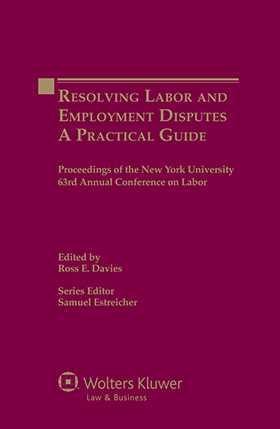
Product Line | Kluwer Law International |
|---|---|
Product SKU | 10058495-0001 |
ISBN-13 | 9789041140784 |
Availability | Ships in 3-5 Business Days |
Last Updated | 2012-08-2 |
In today’s political and economic climate, broad and easy agreement with the basic premise of labor law – to stimulate the economy by putting more money into the pockets of working people – is not likely. Bad economic times are generally not good for labor organization and labor standards. There is, of course, still an important for labor and employment and good practices to help resolve employment disputes. New York University’s venerable and prestigious Center for Labor and Employment Law has always been dedicated to the underlying principles of labor law as expressed in the National Labor Relations Act seventy-five years ago, despite recent economic challenges unforeseen at that time.
The Center’s 2010 conference (the 63rd in this highly influential series) was built around a stocktaking of the current condition of labor law in the United States, focusing on the continuities and disparities that characterize practice in the field today. This volume contains papers presented at that meeting, all here updated to reflect recent developments. Extending beyond the NLRA itself, contributors discuss the effects of later legislation such as the Wagner and Taft-Hartley Acts of 1947, agencies such as the Equal Employment Opportunity Commission and the Office of Federal Contract Compliance Programs, and proliferating connections between labor relations law and intellectual property law. Experts from both the practicing bar and academia – eighteen in all – call on their unique strengths to address such issues as the following:
Center for Labor and Employment Law at New York University.
Editor’s Preface; R.E. Davies.
Chapter 1. Challenges on the 75th Anniversary of the National Labor Relations Act; W.B. Liebman.
Part I. Making Your Case Before the NLRB.
Chapter 2. Class Action Arbitration Waivers and § 7 Rights; M. Babson, B. Murphy.
Chapter 3. NLRB General Counsel Initiative on § 10(j) Relief; L. Solomon.
Chapter 4. The Management Perspective: A Management Practitioner’s Observations Concerning the Latest General Counsel’s Initiatives Regarding the Use of 10(j) Injunctions during Organizing Campaigns; L.P. DiLorenzo.
Part 2. The NLRB General Counsel.
Chapter 5 . Office of the NLRB General Counsel: A Retrospective, 2006–2010; R. Meisburg.
Part 3. Litigating an Employee Intellectual Property/Trade Secret Case.
Chapter 6. Enforcing Restrictive Covenants and Protection of Trade Secrets: An Overview of Applicable Legal Principles; M. Delikat, J. McQuade .
Chapter 7. Trade Secrets and the Computer Fraud and Abuse Act; L. Berke-Weiss.
Part 4. Defending Actions Brought by the EEOC.
Chapter 8 . Getting Ready for Increased Systemic EEO Enforcement; G. Siniscalco, J. Rosenberg.
Part 5. Class Certification in Wage-Hour Litigation.
Chapter 9 . New Developments in Employment Class Actions; Z.D. Fasman .
Part 6. Dealing with an OFCCP Audit.
Chapter 10. Best Practices for Federal Contractors; K. Parker.
Part 7. Department of Labor Litigation and Regulatory Initiatives.
Chapter 11. Insight from the New Sheriff’s Top Lawyer: Perspective from the Solicitor’s Office; M.P. Smith.
Chapter 12. Fissured Employment; D. Weil.
Part 8. Representation and Regulation.
Chapter 13. Mandatory Disclosure in the Market for Union Representation; M.T. Bodie.
Part 9. Ethical Issues for In-House Counsel.
Chapter 14. Selected Ethics and Professionalism Issues for Labor and Employment Lawyers; D.P. Duffy.
 NEED HELP FINDING THE RIGHT SOLUTION?
Call sales at 1-800-638-8437
HAVE A QUESTION?


These cookies are necessary for the website to function. They are usually set in response to actions made by you which amount to a request for services, such as setting your privacy preferences, logging in or filling in forms. You can set your browser to block or alert you about these cookies, this may have an effect on the proper functioning of (parts of) the site.
These cookies enable the website to provide enhanced functionality, user experience and personalization, and may be set by us or by third party providers whose services we have added to our pages. If you do not allow these cookies, then some or all of these services may not function properly.
These cookies support analytic services that measure and improve the performance of our site. They help us know which pages are the most and least popular and see how visitors move around the site.
These cookies may collect insights to issue personalized content and advertising on our own and other websites, and may be set through our site by third party providers. If you do not allow these cookies, you may still see basic advertising on your browser that is generic and not based on your interests.
