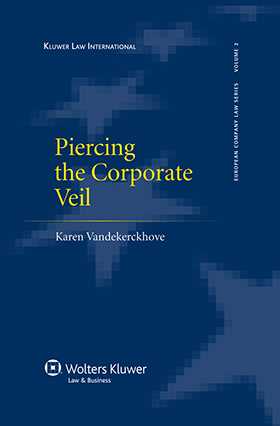
Product Line | Kluwer Law International |
|---|---|
Product SKU | 10059398-0001 |
ISBN-13 | 9789041125910 |
Availability | Ships in 3-5 Business Days |
Last Updated | 2007-07-27 |
When courts ‘pierce the corporate veil’, they disregard the separateness
of the corporation and hold a shareholder responsible for the corporation’s
action as if it were the shareholder’s own. Although as a general rule the
courts are reluctant to allow corporate veil piercing, creditors of an
insolvent corporation frequently attempt to hold the shareholders liable when
they cannot obtain satisfaction from their debtor. In the United States, in
fact, piercing claims constitute the single most litigated area in corporate
law. This study clears up some of the mists hanging around the concept of
corporate veil piercing. What exactly is corporate veil piercing and in which
situations does it occur? What are the legal rules involved? Following a short
overview of the applicable law in the six legal systems that are the subject
of this study-those of Belgium, the Netherlands, France, Germany, the United
Kingdom, and the United States-the author proceeds with a more profound
analysis from a functional comparative perspective, starting from particular
situations that typically call for shareholder liability for the debts of
subsidiary companies. Among the grounds for veil piercing claims the author
discusses the following, along with the substantive and procedural law and
important cases associated with each in the six jurisdictions covered:
In the course of the presentation, a thorough analysis of legal scholarship in the area leads to numerous applications of the various theories and doctrines that can be brought to bear on veil piercing cases. In addition, an in-depth discussion of the international dimension of corporate veil piercing focuses on the question of which laws should govern the liability of a parent corporation for the debts of its subsidiary. Throughout, the author’s clear insight into the substantive law of veil piercing sheds light on traditional misconceptions in the conflict of laws on the issue. She also details initiatives undertaken by various international bodies, including the United Nations, the Organization for Economic Cooperation and Development, the European Union, the International Court of Justice, and the International Labour Organization. Dr Vandekerckhove’s study is the most comprehensive, far-reaching, and up-to-date study of this important growing area of corporate law practice. As such it will prove of great value to practitioners, judges, and academics in the field, and will prove its worth anywhere in the world where the presence of multinational corporations is felt.
Part I. Introduction. Chapter 1. Legal and Historical Background of the Principles Concerned by Corporate Veil Piercing. Chapter 2. Terminology and Scope of Study. Part II. Comparative Analysis of the Substantive Law on Corporate Veil Piercing. Chapter 3. General Overview of Piercing of the Corporate Veil in the Legal Systems Analysed. Chapter 4. Functional Comparison of Some Capita Selecta. Chapter 5. Some Solutions to Corporate Veil Piercing Issues. Chapter 6. Initiatives on the International Level. Part III. Conflict of Laws Relating to Piercing of the Corporate Veil. Chapter 7. Methodology Relating to the Conflict of Laws with Regard to Corporate Veil Piercing. Chapter 8. Theories Relating to Conflict of Laws in Regard to Piercing of the Corporate Veil. Chapter 9. Piercing of the Corporate Veil in the Conflict of Laws. Chapter 10. Conclusion.
 NEED HELP FINDING THE RIGHT SOLUTION?
Call sales at 1-800-638-8437
HAVE A QUESTION?


These cookies are necessary for the website to function. They are usually set in response to actions made by you which amount to a request for services, such as setting your privacy preferences, logging in or filling in forms. You can set your browser to block or alert you about these cookies, this may have an effect on the proper functioning of (parts of) the site.
These cookies enable the website to provide enhanced functionality, user experience and personalization, and may be set by us or by third party providers whose services we have added to our pages. If you do not allow these cookies, then some or all of these services may not function properly.
These cookies support analytic services that measure and improve the performance of our site. They help us know which pages are the most and least popular and see how visitors move around the site.
These cookies may collect insights to issue personalized content and advertising on our own and other websites, and may be set through our site by third party providers. If you do not allow these cookies, you may still see basic advertising on your browser that is generic and not based on your interests.
