Product Line | Kluwer Law International |
|---|---|
ISBN-13 | 9789403526690 |
Availability | Ships in 5-7 Business Days |
Last Updated | 2025-11-06 |
About this book:
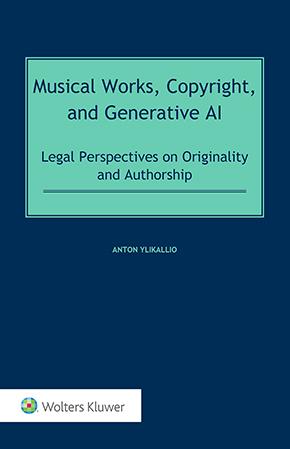
Musical Works, Copyright, and Generative AI focuses on copyright protection for musical compositions. It introduces a novel framework that deconstructs the compositional process into three components – the underlying work, the source material, and prospective reproductions – providing a clearer understanding of creative input and a more practical way to evaluate whether artificial intelligence (AI)-generated music should qualify for protection. As AI tools for creative production become more widespread, the question of copyright protection for AI-generated works is becoming an increasingly significant issue.
What’s in this book:
Based on a wide range of case law and analogies from traditional frameworks for assessing musical compositions in a copyright law context, the analysis suggests that copyright eligibility hinges on the specificity and precision of the instructions shaping the musical work, as well as how clearly they are reflected in the resulting composition. To this end, the author addresses the following seminal questions:
Pragmatic case studies compare AI-assisted and traditional creative processes to examine the relevant legal issues. To enhance the clarity of the analysis, sheet music samples and scores are incorporated, and audio samples are available via a QR code linking to a dedicated database.
How this will help you:
The book sets itself apart by enhancing professional understanding of how generative AI challenges traditional copyright principles, furnishing clarity on originality and authorship in a rapidly evolving technological landscape. As a trailblazing, in-depth, structured approach to determining the role of human creativity in AI-assisted endeavours, this study offers a forward-looking perspective on how intellectual property law can adapt to evolving modes of creative production. It equips legal practitioners, scholars, creators, developers, and policymakers with analytical tools and benchmarks to assess the copyright eligibility of AI-generated works.
Preface
Acknowledgements
Introduction
CHAPTER 1
Introduction, Research Premise, and Methodology
CHAPTER 2
Generative AI: Technical Details and History
CHAPTER 3
The Criteria for Determining Copyright Eligibility
CHAPTER 4
The Requirement of Authorial Intent
CHAPTER 5
The Three-Stage Ontology of a Work
CHAPTER 6
Authorship of Manual Template Compositions
CHAPTER 7
AI-Assisted Template Compositions
CHAPTER 8
Conclusions and Final Reflections
Appendix
Bibliography
Index
 NEED HELP FINDING THE RIGHT SOLUTION?
Call sales at 1-800-638-8437
HAVE A QUESTION?


These cookies are necessary for the website to function. They are usually set in response to actions made by you which amount to a request for services, such as setting your privacy preferences, logging in or filling in forms. You can set your browser to block or alert you about these cookies, this may have an effect on the proper functioning of (parts of) the site.
These cookies enable the website to provide enhanced functionality, user experience and personalization, and may be set by us or by third party providers whose services we have added to our pages. If you do not allow these cookies, then some or all of these services may not function properly.
These cookies support analytic services that measure and improve the performance of our site. They help us know which pages are the most and least popular and see how visitors move around the site.
These cookies may collect insights to issue personalized content and advertising on our own and other websites, and may be set through our site by third party providers. If you do not allow these cookies, you may still see basic advertising on your browser that is generic and not based on your interests.
