Product Line | Kluwer Law International |
|---|---|
ISBN-13 | 9789403544267 |
Availability | Ships in 5-7 Business Days |
Last Updated | 2026-01-23 |
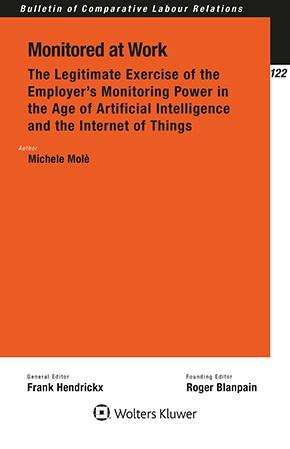
Bulletin of Comparative Labour Relations Volume #122
Monitored at Work is a legal study, beyond the traditional privacy paradigm, that explores the historical and conceptual foundations of the employer’s monitoring power, tracing its evolution from the Industrial Revolution to the most recent developments in data science – Artificial Intelligence (AI) and Internet of Things (IoT). Employers deploy these technologies to evaluate work performance, assess personal characteristics, and safeguard property, health, and safety. The book highlights how technological innovation has reshaped managerial authority and examines the influential role of technology developers in this process. The study further analyses how these developments affect the enjoyment of employees’ fundamental rights within the European Union (EU) legal framework, including the rights to non-discrimination, freedom of expression, and freedom of assembly and association. The book offers a holistic understanding of the employer’s monitoring power and examines the conditions for its legitimate exercise under the General Data Protection Regulation (GDPR) and the Artificial Intelligence Act (AI Act). It provides a normative critique of both Regulations, exploring the specific protection needs of employees.
What’s in this book:
The Author’s focus is on:
Furthermore, the analysis integrates relevant jurisprudence from the European Court of Human Rights (ECtHR) and the European Court of Justice (ECJ) to assess the legitimacy of monitoring practices. The study also outlines potential solutions to address existing limitations and gaps in the GDPR and the AI Act, drawing in particular on the Data Protection Impact Assessment (DPIA, Article 35 GDPR), Article 88 GDPR, and recent legislative developments introduced by the Platform Work Directive (PWD).
How this will help you:
Through its assessment of the effectiveness of EU legislation in safeguarding employees against the illegitimate exercise of the employer’s monitoring power, this book offers a comprehensive examination of how AI and IoT-enabled monitoring technologies challenge employees’ rights. By elucidating the legal and ethical implications of these technologies, it equips practitioners with the tools to anticipate and mitigate compliance risks under both the GDPR and the AI Act. Furthermore, the book contributes to the ongoing scholarly and policymaking debate by analysing emerging regulatory developments that could further shape the future of the digitally monitored workplace.
About the Author
Funding Acknowledgements
List of Abbreviations
List of Tables
CHAPTER 1
Introduction
CHAPTER 2
Between Mirrors and Sensors: On the Origins of the Employer’s Monitoring Power
CHAPTER 3
On the Legitimate Exercise of the Employer’s Monitoring Power in the European Fundamental Rights Framework
CHAPTER 4
The Impact of AI and IoT-Enabled Technologies on the Exercise of the Employer’s Monitoring Power
CHAPTER 5
A Fundamental Rights Assessment of the Exercise of an AI and IoT-Enabled Employer’s Monitoring Power
CHAPTER 6
Putting the GDPR to Work: Requirements for a Legitimate Exercise of the Employer’s Monitoring Power via AI and IoT-Enabled Technologies
CHAPTER 7
Applying the AI Act to the Employment Context: Requirements for a Legitimate Exercise of the Employer’s Monitoring Power via AI and IoT-Enabled Technologies
CHAPTER 8
The Limitations of the GDPR and AI Act in the Employment Context
CHAPTER 9
Existing Avenues Within the Current EU Legal Framework to Address an Illegitimate Exercise of the AI and IoT-Enabled Employer’s Monitoring Power
CHAPTER 10
Conclusion
Bibliography
Table of Cases
Table of Legislation
How can we assess the new forms of surveillance and control that they allow in the context of fundamental rights, the law data protection and artificial intelligence law? These are the questions that Michele Molè addresses in his book. His developments and conclusions, remarkable for their innovative aspect and the clarity of these should be of interest to lawyers, at the frontiers of labour law, data protection and artificial intelligence. This fascinating book solidly argued and using the most diverse sources (law, of course, but also technical, computer science, history, etc.) in a synthesis. (translated to English) —Philippe Ehrenström, Lawyer, LL.M., Schulthess Digital 02.04. 2026
A very clear and well-structured dissertation, which is highly recommended for anyone interested in the protection of employees who are monitored by AI- and IoT-driven technologies. I certainly learned a lot from it. Moreover, the book offers valuable starting points for judges, data protection authorities, and employees (representatives) in shaping more effective supervision of this rapidly evolving practice. (translated to English) —Prof. Dr. Anja Eleveld, Professor of Empirical-Legal Studies of Precarious Work and Poverty at the Vrije Universiteit Amsterdam (VU). Tijdschrift Recht en Arbeid 2026/52
 NEED HELP FINDING THE RIGHT SOLUTION?
Call sales at 1-800-638-8437
HAVE A QUESTION?


These cookies are necessary for the website to function. They are usually set in response to actions made by you which amount to a request for services, such as setting your privacy preferences, logging in or filling in forms. You can set your browser to block or alert you about these cookies, this may have an effect on the proper functioning of (parts of) the site.
These cookies enable the website to provide enhanced functionality, user experience and personalization, and may be set by us or by third party providers whose services we have added to our pages. If you do not allow these cookies, then some or all of these services may not function properly.
These cookies support analytic services that measure and improve the performance of our site. They help us know which pages are the most and least popular and see how visitors move around the site.
These cookies may collect insights to issue personalized content and advertising on our own and other websites, and may be set through our site by third party providers. If you do not allow these cookies, you may still see basic advertising on your browser that is generic and not based on your interests.
