Product Line | Wolters Kluwer Legal & Regulatory U.S. |
|---|---|
ISBN-13 | 9781543884166 |
Availability | Ships in 3-5 Business Days |
Publish Frequency | Semi-annually |
Last Updated | 2026-07-21 |
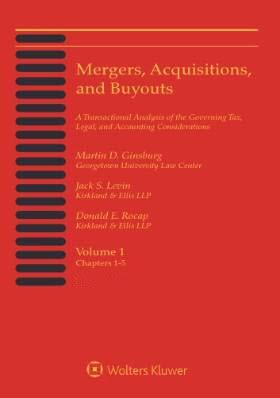
When structuring mergers, acquisitions, or buyouts, there's only one way to be sure that you've thought of all the tax and legal consequences: rely on Martin D. Ginsburg, Jack S. Levin, and Donald E. Rocap as you plan, develop, and execute your strategy.
In this gold-standard resource for mergers, acquisitions, and buyouts analysis and guidance—available as a five-volume print set or digitally on our VitalLaw platform—these expert practitioners offer you:
Whether you represent the buyer, the seller, or another interested party, you can go straight to a model M&A agreement that gives you:
When it comes to companies acquiring other companies—particularly public company acquisitions—seemingly every transaction raises something unique. Mergers, Acquisitions, and Buyouts is recently updated with:
Mergers, Acquisitions, and Buyouts deals not only with the federal income tax aspects of such transactions, but also (although somewhat more briefly) with many of the other aspects of acquisitions, including state corporate law, securities law, accounting, fraudulent conveyance law, antitrust reporting, and contract terms that are important in negotiating, structuring, and effectuating an acquisition.
Volumes 1-4: Transactional Analysis
1. Introduction, Overview and Definitions
2. Taxable Purchase of Target’s Stock and Taxable Reverse Subsidiary Merger
Chapter 2 deals with Purchaser's taxable purchase of Target’s stock, including Purchaser's acquisition of Target through a taxable reverse subsidiary merger.
3. Taxable Purchase of Target’s Assets and Taxable Forward Merger
Chapter 3 deals with Purchaser's taxable purchase of Target’s assets, including Purchaser's acquisition of Target through a taxable forward merger.
4. Taxable Acquisitions: Acquisition Expenses, Stepped-Up Basis Allocation, Intangibles, Amortization, Non-Compete Covenant, Tax Receivable Agreement, etc.
Chapter 4 deals with many of the collateral issues in a taxable acquisition, including deductibility of Target’s and Purchaser's expenses of the acquisition, determining whether to structure the acquisition for asset SUB or asset COB, allocating the purchase price among the acquired assets in an SUB transaction, amortization of SUB intangible assets, consulting payments, non-compete covenants, §1253 franchise payments, contingent-interest debt, tax receivable agreements, and the risk of inadvertent asset COB, and zero basis problems where Purchaser stock is delivered by a Purchaser subsidiary.
5. Unwanted Assets
Chapter 5 deals with unwanted Target assets.
6. Tax-Free Reorganization Basic Principles
7. "Solely for Voting Stock" Reorganizations
8. Reorganizations Not "Solely for Voting Stock"
Chapters 6 through 8 deal with transactions intended to qualify as tax-free corporate reorganizations.
9. Code § 351 Acquisitions and Dispositions
Chapter 9 deals with the creative use of Code §351 (COB asset transfer to an 80% controlled corporation partly or entirely in exchange for stock).
10. Tax-Free Spin-Offs
Chapter 10 deals with Code §355 spin-offs.
11. Taxable and Tax-Free S Corp Acquisitions
Chapter 11 deals with the additional issues presented where either Purchaser or Target or both is an S corp.
12. Acquiring or Restructuring Distressed Company, Including Debt Cancellation Income and NOLs
Chapter 12 deals with the acquisition or restructuring of a financially distressed C corp, S corp, partnership, or LLC, including consequences to LossCo and its creditors from a restructuring and effects of an acquisition on LossCo's NOLs and other tax attributes.
13. Tax Aspects of LBO Financing—Debt and Preferred Stock
14. Tax Aspects of LBO Structuring
Chapters 13 and 14 deal with a number of the issues that arise most often in LBOs, but also in other acquisitions, including the deductibility of interest on money borrowed to make the acquisition or on debt securities issued in the acquisition, the tax treatment of original issue discount on debt and preferred stock issued to finance the acquisition, the tax consequences when such preferred stock is redeemed, and alternative approaches to structuring an LBO.
15. Management Compensation
Chapter 15 deals with the tax and accounting aspects of compensating Target’s, Purchaser's, or Newco's management (including ISOs, NQOs, SARs, deferred compensation, vested or unvested stock or deferred compensation, and golden parachute tax rules).
16. Acquisitions and Dispositions Using Partnership, LLC, or REIT
Chapter 16 deals with the use of partnerships, LLCs, and REITs in acquisitions, dispositions, and buyouts (including state partnership and LLC laws).
17. Non-Tax Acquisition Issues, Including SEC, State Entity Law, ERISA Group Liability, Accounting, Fraudulent Conveyance, and HSR Antitrust Reporting
Chapter 17 deals with non-tax issues in transactions (although many non-tax structuring issues are also dealt with in Chapters 1 through 16), including state corporate, partnership, and LLC laws, Purchaser's and Target’s deal protective measures, federal securities law, stock exchange rules, purchase accounting, fraudulent conveyances, Hart-Scott-Rodino antitrust reporting rules, ERISA group liability, and general structuring considerations.
18-20 Reserved.
Table of Internal Revenue Code Sections
Table of Treasury Regulations
Table of Treasury Rulings
Table of Securities Laws
Table of FASB Statements
Table of Cases
Index
Volume 5: Sample Acquisition Agreements with Tax and Legal Analysis
21. Introduction to and Explanation of Sample Acquisition Agreements
22. Taxable Purchase of Stock
23. Taxable Purchase of Assets
24. Taxable Purchase of Divisional Business
25. Taxable Reverse Subsidiary Merger
26. Tax-Free Merger
Volume 5 contains sample acquisition agreements and commentary on the tax and other aspects of those sample agreements, including sample agreements for:
as well as additional terms that can be incorporated where Target is a subsidiary in a consolidated group of corporations, Target is an S corp, and/or there is a purchase price adjustment based on Target’s closing date balance sheet.
"…the best work of its kind I have ever used. This should be the first reference book for anyone with a transactional practice."
— Mark L. Yecies, former Director of Ernst & Young LLP's National M&A Tax Department, and former Chairman of ABA Tax Section's Corporate Tax Committee
 NEED HELP FINDING THE RIGHT SOLUTION?
Call sales at 1-800-638-8437
HAVE A QUESTION?


These cookies are necessary for the website to function. They are usually set in response to actions made by you which amount to a request for services, such as setting your privacy preferences, logging in or filling in forms. You can set your browser to block or alert you about these cookies, this may have an effect on the proper functioning of (parts of) the site.
These cookies enable the website to provide enhanced functionality, user experience and personalization, and may be set by us or by third party providers whose services we have added to our pages. If you do not allow these cookies, then some or all of these services may not function properly.
These cookies support analytic services that measure and improve the performance of our site. They help us know which pages are the most and least popular and see how visitors move around the site.
These cookies may collect insights to issue personalized content and advertising on our own and other websites, and may be set through our site by third party providers. If you do not allow these cookies, you may still see basic advertising on your browser that is generic and not based on your interests.
