Product Line | Kluwer Law International |
|---|---|
ISBN-13 | 9789403527994 |
Availability | Ships in 5-7 Business Days |
Last Updated | 2025-04-22 |
International Arbitration Law Library #73
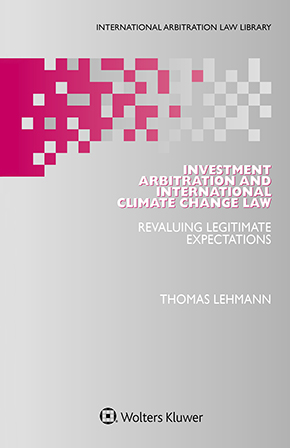
Investment Arbitration and International Climate Change Law is an indispensable book presenting the first in-depth analysis of the nexus of international climate change law (ICCL) with investors’ legitimate expectations, offering practical ways to integrate ICCL in the resolution of energy investment disputes. Climate change policies are triggering an increasing number of investment disputes, even as political concern grows that international investment treaties may impede climate change action.
What’s in this book:
Based on forty-two publicly available arbitral awards and state-of-the-art doctrinal research, the author provides compelling new insights on the following:
An invaluable annex presents details on a range of energy disputes and awards, including decisions on legitimate expectations, investor due diligence, and climate change.
How this will help you:
This timely work provides directly beneficial information for arbitration practitioners and policymakers on the interplay between investment protection and climate change. The ordered structure of its presentation will prove to be invaluable to energy investors and their counsel, government officials, and scholars.
List of Abbreviations
Foreword
Preface
Acknowledgements
Introduction
CHAPTER 1 Energy Investment Protection in the Net Zero Transition
CHAPTER 2 The Substantive Protection of Legitimate Expectations under the Standard of FET
CHAPTER 3 Interpretation and Application of Legitimate Expectations in NZEID under the Energy Charter Treaty
CHAPTER 4 The Factual Integration of ICCL in Legitimate Expectations
CHAPTER 5 Factoring ICCL into Energy Investors’ Legitimate Expectations
CHAPTER 6 Reconciling International Investment Law with ICCL
General Conclusion
ANNEX Legitimate Expectations in Net Zero Energy Investment Disputes: Selected Quotes
Glossary
Bibliography
Table of Cases
Table of Treaties and Legislation
Investment Arbitration and International Climate Change Law: Revaluing Legitimate Expectations is a carefully argued, and usefully pragmatic book. It speaks to tribunals in their own doctrinal language, supplies an evidentiary theory for integrating ICCL into LE, and respects both the urgency of climate action and the rule of law values of predictability and reliance. The book does a great job in arming both investors and States with principled arguments that are legible to arbitral tribunals and rooted in existing case law. According to ICSID statistics, cases relating to oil, gas, and mining, in addition to electric power and other energy, make up almost half of the cases on its docket, with a steady flow of ECTbased claims.4 However, claiming that investment arbitration is to blame for State climate inaction is a strawman argument.5 It is also true that the distribution of the burdens of our energy transition needs constant attention, and arbitral tribunals have their role to play in this, as long as States agree to it. But tribunals cannot substitute for the political economy of just transition. I recommend the book as a great source of inspiration for what lawyers often engage in: reimagining the law in response to change.— By Bálint Kovács - ICSID Review - Foreign Investment Law Journal 23 July 2026
His book helps explain the paradox of a growing academic interest in a field – the intersection of climate change law and policy and investment arbitration – despite the relatively few actual ISDS disputes crystallised so far. As an arbitration expert, Lehmann seeks to explore how international investment and climate change law can complement one another, aligning with those who view investment arbitration as a potential ally in the climate transition. His study constitutes a valuable and timely contribution that lays a solid foundation for a broader and much-needed discussion on the evolving relationship between international investment law and climate change.— Camille Martini - The Law and Practice of International Courts and Tribunals 24 (20 25) 1–5
With his research, the author makes a significant contribution to the construction of an emerging discipline, and at the same time demonstrates the persistence of the classical, traditional notions of public international law, confronted with the principles of this new branch of law, closely linked to present and future economic development. It is a work of mandatory reference. (translated to English) —Pierre-Jean Thil - Cuadernos de Derecho Transnacional (Octubre 2025), Vol. 17
This book stands out for its theoretical precision and methodological creativity. By summarizing the factual assessment of LEs in energy investment arbitration awards, Dr Lehmann shows how arbitral tribunals could integrate ICCL into IIL, especially into investment arbitration constructively and without undermining the stability of the investment regime. While some normative and institutional questions remain open, the book offers a clear and innovative pathway forward that deserves attention from both scholars and practitioners. It will be of particular interest to scholars, arbitrators, and policymakers working at the intersection of investment protection and climate governance. — Simeng Wang - European Investment Law and Arbitration Review Volume 10, Issue 2, 2025
After reading this book, we must echo Prof. Dr. Klaus Sachs' observation in his foreword that "[i]t is not difficult to predict that this book will soon land on the desk of any practitioner in the field" (page xv). The book (which tellingly begins by quoting the formulation of Kant's categorical imperative) reminds us that we must find ways under international law or otherwise to make sure that the protection of individual rights will not affect ICCL in achieving its monumental goal. — Eduardo Silva – Romero, Cahiers de l'arbitrage 1 juillet 2025
The book’s targeted and well-substantiated analysis, based on Lehmann’s doctoral research, offers a significant and original contribution to the growing literature at the intersection of climate change and investment arbitration. — Camille Martini - The Law & Practice of International Courts and Tribunals – October 2025
The book offers a clear and innovative pathway forward that deserves attention from both scholars and practitioners. It will be of particular interest to scholars, arbitrators, and policymakers working at the intersection of investment protection and climate governance. — Simeng Wang, PhD candidate at Durham Law School - European Investment Law and Arbitration Review Issue 2 -2025
Investment Arbitration and International Climate Change Law: Revaluing Legitimate Expectations, is a valuable contribution to those engaged in the resolution of investor-state disputes in the energy sector. Whether you are an investor, counsel to an investor, a state, counsel to a state, or an arbitrator facing changing climate policies, this book should be added to your library. — Joseph M. Matthews – TDM April 2025
 NEED HELP FINDING THE RIGHT SOLUTION?
Call sales at 1-800-638-8437
HAVE A QUESTION?


These cookies are necessary for the website to function. They are usually set in response to actions made by you which amount to a request for services, such as setting your privacy preferences, logging in or filling in forms. You can set your browser to block or alert you about these cookies, this may have an effect on the proper functioning of (parts of) the site.
These cookies enable the website to provide enhanced functionality, user experience and personalization, and may be set by us or by third party providers whose services we have added to our pages. If you do not allow these cookies, then some or all of these services may not function properly.
These cookies support analytic services that measure and improve the performance of our site. They help us know which pages are the most and least popular and see how visitors move around the site.
These cookies may collect insights to issue personalized content and advertising on our own and other websites, and may be set through our site by third party providers. If you do not allow these cookies, you may still see basic advertising on your browser that is generic and not based on your interests.
