Product Line | Kluwer Law International |
|---|---|
ISBN-13 | 9789403542072 |
Availability | Ships in 5-7 Business Days |
Last Updated | 2023-12-14 |
About this book:
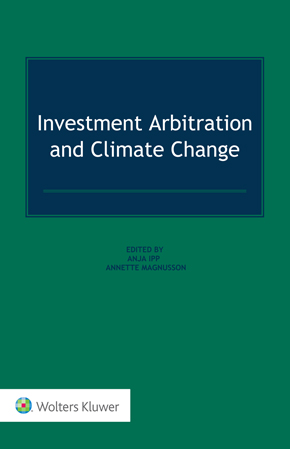
Investment Arbitration and Climate Change is a comprehensive elaboration wherein stellar experts and practitioners describe different types of climate-related investment disputes, provide a thorough analysis of the unique procedural issues that emerge in such disputes, and evaluate the proper balance between States’ right to regulate to fight climate change and their obligations towards foreign investors. At the nexus between international investment law, climate law, and human rights law, States’ obligations to protect foreign investments clash with their right – or even their duty – to regulate to protect the planet and people. State efforts at climate change mitigation and adaptation have already triggered liability claims under the investor-protection provisions of bilateral and multilateral investment treaties.
What’s in this book:
Every contribution of this book furnishes a penetrating perspective on this complex matter, elucidating the following aspects:
How this will help you:
Along the way, arbitrators and other practitioners will gain insight into how to argue, defend, and assess climate-related investment disputes using investment-treaty case law and international climate agreements, human rights law, and environmental law. Policymakers are shown ways to design and implement climate policy and investment treaties to avoid claims by foreign investors.
For policymakers, treaty and contract negotiators, dispute resolution lawyers, and international organizations, no other resource provides such incisive discussion of balancing treaty-based investment protection against states’ inherent duty to regulate in the public interest.
Editors
Contributors
Foreword
Introduction
Anja Ipp & Annette Magnusson
PART I
Types of Disputes
CHAPTER 1
Types of State Action Leading to Climate-Related Investor Claims
Beata Gessel-Kalinowska vel Kalisz, Maja Frontczak & Piotr Paprota
CHAPTER 2
Carbon Markets, Emissions Trading, and Investor-State Disputes
Marisa Martin & Paul Barker
CHAPTER 3
International Commercial Arbitration and Investment Agreements Involving States
Wendy Miles KC
PART II
Procedural Issues
CHAPTER 4
Climate Science: A Role to Play at Every Stage of Investment Arbitration?
Caline Mouawad & Gretta Walters
CHAPTER 5
Climate-Related Counterclaims in International Investment Arbitration
Maxi Scherer & Clara Reichenbach
CHAPTER 6
Valuation of Compensation in Fossil Fuel Phase-Out Disputes
Oliver Hailes
PART III
States’ Right to Regulate
CHAPTER 7
Regulating for Climate Change Without Breaching Investment Treaties
Manish Aggarwal & Ridhi Kabra
CHAPTER 8
Investor-State Disputes, the Climate Emergency, and the Duty to Regulate Fossil Fuels: A Human Rights Perspective
Helionor de Anzizu & Nikki Reisch
CHAPTER 9
Reconciling Human Rights and Investor Rights: The Case of Climate Change
Suzanne Spears
PART IV
Investment Treaties and Energy Transition
CHAPTER 10
The Energy Charter Treaty: A Friend or Foe of Decarbonisation?
Patrick W. Pearsall, David Ingle & Gary Smadja
CHAPTER 11
The Role and Relevance of Investment Treaties in Promoting Renewable Energy Investments
Ladan Mehranvar & Lisa Sachs
This book represents a landmark contribution to an emerging field of critical importance. Its success in framing the legal, normative, and practical questions that dominate climate-investment interactions makes it an indispensable resource for practitioners, scholars, and policymakers.
While the book refrains from offering a singular vision for reform, it succeeds in its more fundamental objective: creating space for the dialogue, analysis, and innovation necessary to reconcile investment protection with climate justice. In doing so, it makes an essential contribution to both legal scholarship and the urgent practical work of climate governance in an interconnected world. —Professor A F M Maniruzzaman / TDM Vol. 22, Issue 3 September 2025
The book presents a timely response to climate change crises and the incoming related disputes with many arguments that merit deep reflection. Counsel for investors and defendant States, as well as organizations participating with amicus curiae interests in investment arbitration, are encouraged to engage with this book and its distinct perspectives. —Orlando Federico Cabrera Colorado, ICSID Review (2024)
Investment Arbitration & Climate Change expertly bridges the gap between international investment law and the imperative to address climate change. By bringing together diverse perspectives, the editors and contributors illuminate the multifaceted challenges and opportunities at this critical intersection. The book highlights the polarized views within the legal community, presenting arguments from both proponents and critics of the current investment arbitration framework without achieving a consensus. This lack of consensus underscores the complexity and contentiousness of reconciling investment protection with climate action. While the book offers a robust analysis of current issues, it also acknowledges areas re quiring further exploration. Future research could delve deeper into the practical implementation of treaty reforms, the evolving role of climate science in arbitration, and the mechanisms for ensuring that investment protection does not undermine urgent climate goals. As the legal landscape continues to evolve, this volume serves as a foundational text, encouraging ongoing dialogue and innovative approaches to harmonize investment arbitration with the global climate transition. The book not only provides a comprehensive overview but also sets the stage for future developments in this vital area of law. —Alexandre Vagenheim Vice President Global Legal Data, Jus Mundi – Jus Mundi Arbitration Review Issue 1, 2024
This collection of eleven essays is the first book to be published on the problem of adapting the system of protection of foreign investment, particularly the key component of investor-State arbitration, to the entry into force of the 2015 Paris Agreement. Published under the editorship of the co-founders of Climate Change Counsel, it provides lawyers concerned with the workings of the system with an invaluable explanation of the problems that it faces. Appearing at a time when the system of investor-State dispute settlement is undergoing reform at the UN Commission on International Trade Law in response to widespread criticism alongside an initiative at the Organisation for Economic Cooperation and Development to develop reforms to adapt the system to the Paris Agreement, the book provides a wide-ranging survey of practical and policy issues written by a formidable group of experts.
While treaties are currently the most important basis of investment claims by volume and the OECD Track 1 programme is investigating their potential reform to align them to the Paris Agreement, the book rightly identifies the question of foreign investor claims based on State contracts as a significant question. As some voices in the investor-State arbitration community (eg, Alexis Mourre) publicly speculate on a shift from treaty-based investor-State dispute settlement to a greater reliance on State contracts, the standards of protection negotiated by host States with individual investors in such contracts is a pertinent issue discussed by Gessel-Kalinowska and others in Chapter 1, as well as by Wendy Miles KC in the context of international commercial arbitration in Chapter 3. In light of the ongoing withdrawals of counterparties from the Energy Charter Treaty (the latest being the United Kingdom) as discussed by PW Pearsall and others in Chapter 10, there is an open question to what extent future foreign investments in the energy sector will be regulated by other investment treaties or the State contract itself. —Arman Sarvarian - British Yearbook of International Law April 2024
 NEED HELP FINDING THE RIGHT SOLUTION?
Call sales at 1-800-638-8437
HAVE A QUESTION?


These cookies are necessary for the website to function. They are usually set in response to actions made by you which amount to a request for services, such as setting your privacy preferences, logging in or filling in forms. You can set your browser to block or alert you about these cookies, this may have an effect on the proper functioning of (parts of) the site.
These cookies enable the website to provide enhanced functionality, user experience and personalization, and may be set by us or by third party providers whose services we have added to our pages. If you do not allow these cookies, then some or all of these services may not function properly.
These cookies support analytic services that measure and improve the performance of our site. They help us know which pages are the most and least popular and see how visitors move around the site.
These cookies may collect insights to issue personalized content and advertising on our own and other websites, and may be set through our site by third party providers. If you do not allow these cookies, you may still see basic advertising on your browser that is generic and not based on your interests.
