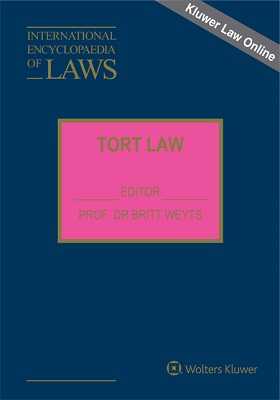
Product Line | Kluwer Law International |
|---|---|
Product SKU | 10057173 |
In an international encyclopedia, a proper place is definitely to be devoted to the Law on Tort. This legal area is important for lawyer and citizen alike. The problems of prevention of harm and loss allocation are not only extremely diverse but also universal and fundamental. This traditional branch of law not only tackles questions which concern every lawyer, whatever is his legal expertise, but it also concerns on a worldwide scale each person's most fundamental rights, such as his right to bodily integrity, his right to a manworthy existence and his property rights. The way a legal system protects rights and interests through, among others, tort law co-determines the degree of civilisation and the development of a given society.
However, no matter how fundamental tort issues may be, it is striking how the solutions offered in one system can be very different and sometimes quite diverse from those in another. There are basic differences in approach between the legal systems and the dividing line does not always match the classic divide between the countries of the Civil Law tradition and those belonging to the Common Law tradition.
In the General Introduction, particular attention will be paid to the aims of the law of Torts and to the distinction between tort and crime and to the relationship between tort and contract (is concurrence between tortious liability and contractual responsibility permitted or not? what about precontractual liability?). For each country, the scope of protection will be tackled as well (are all interests equally protected?).
For more information and an up-to-date list of the countries for this looseleaf, go to KluwerLawOnline.
For detailed information on all volumes of the Encyclopaedia, please visit: www.IELaws.com.
Each monograph follows the outline below:
The Author. Table of Contents. List of Abbreviations.
General Introduction. Selected Bibliography
Part I. Liability for One's Own Acts.
1. General Principles.
2. Specific Cases of Liability (are all tort feasors subject to
the same rules).
Part II. Liability for Acts of Others.
1. Vicarious Liability.
2. Liability of Parents, Teachers and Instructors.
3. Liability for Handicapped Persons.
4. Liability for Things and Animals.
Part III. Forms of Strict Liability.
1. Road and Traffic Accidents.
2. Product Liability.
3. Liability for Service.
4. Environmental Liability.
5. Others.
Part IV. Defenses and Exception Clauses.
1. Limitation of Action (suspension and interruption).
2. Grounds of Justification.
3. Contributory Fault.
4. Exemption Clauses.
Part V. Causation.
Part VI. Remedies.
1. General Principles.
2. Kinds of Damages.
3. Assessment and Compensation of Damages.
4. Personal Injury and Death.
5. Various Damages (property) .
6. Interference with Collateral Benefits.
7. Other Remedies.
Selected Bibliography.
Index
Current Contents
FRONT MATTER: International Advisory Board; Encyclopaedias and Editors; Introducing the International Encyclopaedia of Laws; Curriculum Vitae of the General Editor.
GENERAL SECTION: List of Contributors; Introducing the International Encyclopaedia of Tort Law; Curriculum Vitae of the Editor.
For more information and an up-to-date list of the countries for this looseleaf, go to KluwerLawOnline.
 NEED HELP FINDING THE RIGHT SOLUTION?
Call sales at 1-800-638-8437
HAVE A QUESTION?


These cookies are necessary for the website to function. They are usually set in response to actions made by you which amount to a request for services, such as setting your privacy preferences, logging in or filling in forms. You can set your browser to block or alert you about these cookies, this may have an effect on the proper functioning of (parts of) the site.
These cookies enable the website to provide enhanced functionality, user experience and personalization, and may be set by us or by third party providers whose services we have added to our pages. If you do not allow these cookies, then some or all of these services may not function properly.
These cookies support analytic services that measure and improve the performance of our site. They help us know which pages are the most and least popular and see how visitors move around the site.
These cookies may collect insights to issue personalized content and advertising on our own and other websites, and may be set through our site by third party providers. If you do not allow these cookies, you may still see basic advertising on your browser that is generic and not based on your interests.
