
Co-Editor; President

Product Line | Kluwer Law International |
|---|---|
Product SKU | 10057151 |
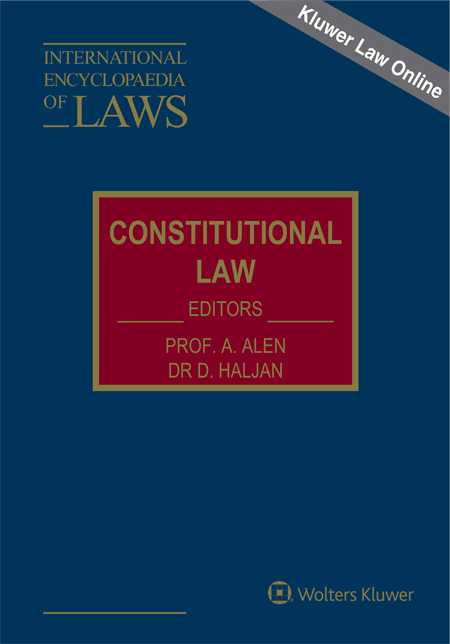
This set of volumes in the International Encyclopaedia of Laws presents a country-by-country survey of constitutional law throughout the world, as well as English translations of the respective constitutions.
I. National Constitutional Law
Each State has a constitution, a set of basic rules determining the organisation and the workings of public authorities and the relation between those authorities and the people. These rules can be written down formally in a “Constitution” or not. Many of these rules usually have a higher legal status and can only be modified through a special procedure. The Encyclopaedia covers a State’s constitution in all these senses, formal and informal, written and unwritten. Each national monograph offers five systematic parts:
II. Texts of Constitutions
The English versions of the Constitutions are edited to highlight matters including structure, language, amendments, and relevant statutes and cases, tying all to the respective national monograph.
III. Sub-national Constitutional Law
The Encyclopaedia also has corresponding monographs on sub-national constitutional law.
For more information and an up-to-date list of the countries for this looseleaf, go to KluwerLawOnline
For detailed information on all volumes of the Encyclopaedia, please visit: www.IELaws.com.
Current Contents
FRONT MATTER: International Advisory Board; Encyclopaedias and Editors; Introducing the International Encyclopaedia of Laws; Curriculum Vitae of the General Editor.
GENERAL SECTION: List of Contributors; Introducing the
International Encyclopaedia of Constitutional Law; Curriculum Vitae of the Editor.
Each monograph follows the outline below:
Introduction. The Authors. Table of Contents. List of Abbreviations. Preface. General Introduction. Selected Bibliography.
Part I: Sources of Constitutional Law (Notion and Hierarchy). 1. Treaties. 2. Constitution. 3. Legislation and Equivalent Legislative Rules. 4. Jurisprudence. 5. Customary Law, Unwritten Law, General Principles of Law. 6. Administrative Regulations and Orders. 7. Codification, Interpretation and Publication.
Part II: Form of Government. 1. General. 2. Head of State. 3. The Legislature. 4. The Executive. 5. The Judiciary. 6. Independent Non-political Bodies in the Legislative or Executive Branch with an Advisory or Supervisory Task.
Part III: The State and its Subdivisions. 1. State Form. 2. Component States or Entities. 3. Decentralized Authorities.
Part IV: Citizenship and the Administration of Justice. 1. Rules Concerning Nationality and Relevance of Nationality. 2. Fundamental Rights and Liberties. 3. Constitutional Problems of Minorities. 4. Judicial Control of Administrative Action. 5. Legal Position of Aliens.
Part V: Specific Problems. 1. War, Treaty, and Foreign Affairs Powers. 2. Taxing and Spending Power. 3. Emergency Laws. 4. The Power of the Military. 5. The Constitutional Relationship Between Church and State. Index.
For more information and an up-to-date list of the countries for this looseleaf, go to KluwerLawOnline


Call sales at 1-800-638-8437
.png)
These cookies are necessary for the website to function. They are usually set in response to actions made by you which amount to a request for services, such as setting your privacy preferences, logging in or filling in forms. You can set your browser to block or alert you about these cookies, this may have an effect on the proper functioning of (parts of) the site.
These cookies enable the website to provide enhanced functionality, user experience and personalization, and may be set by us or by third party providers whose services we have added to our pages. If you do not allow these cookies, then some or all of these services may not function properly.
These cookies support analytic services that measure and improve the performance of our site. They help us know which pages are the most and least popular and see how visitors move around the site.
These cookies may collect insights to issue personalized content and advertising on our own and other websites, and may be set through our site by third party providers. If you do not allow these cookies, you may still see basic advertising on your browser that is generic and not based on your interests.
