Product Line | Kluwer Law International |
|---|---|
Product SKU | 10059171-0001 |
ISBN-13 | 9789041146625 |
Availability | Ships in 3-5 Business Days |
Last Updated | 2013-02-2 |
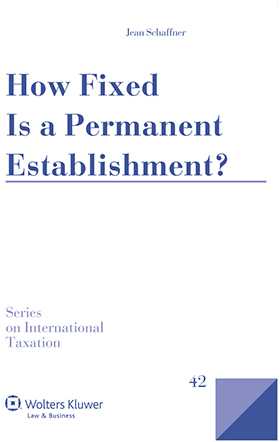
Permanent establishment is the key concept for allocating taxation rights in respect of business income, and the question ‘Is there a permanent establishment?’ is a tax treaty issue that advisers, government officials, and courts perennially confront. Based on a ‘fixed link to the ground’, the idea has become progressively more difficult to apply until, at this stage, re-evaluation has become a political necessity. If a permanent establishment may exist in the context of e-commerce, the concept of a geographical presence must be redefined. However, the question remains: Is e-commerce a sufficient reason for challenging the well-established permanent establishment nexus?
Drawing on case law, administrative practice, and business decisions in numerous jurisdictions, the author discusses the permanent establishment criteria under conditions of e-commerce and the service economy. He shows that the OECD Model Convention and its commentaries already offer the basis for the evolution of the analysis of the concept, and that the preservation of permanent establishment protects and maintains the level playing field between capital importing and capital exporting economies. He examines in depth such elements as the following:
Taking into account important distinctions between two model conventions (OECD and UN), as well as pertinent EU directives and the impact of EU law, the author proposes minor amendments to the OECD Model that adapt it to economic reality and current trends in jurisprudence and that can be implemented immediately. An appendix includes Article 5 and its commentaries as they have evolved since 1963, with the successive addenda and deletions.
The author’s 20-plus years of experience as a tax lawyer lend the presentation a thoroughly practical aspect. The work addresses in more detail than any other publication the topic of profit allocation to a permanent establishment in the e-commerce world, an issue which is evolving rapidly in the current economic environment.
Introduction.
Chapter 1. The Roots of International Tax Law and the Permanent Establishment Concept.
Chapter 2. Historic Evolution of the Permanent Establishment Concept.
Chapter 3. Recent Developments of the Concept of Permanent Establishment.
Chapter 4. The Geographical Location and the Basic Definition: The Physical Permanent Establishment.
Chapter 5. Construction Permanent Establishments.
Chapter 6. Preparatory or Auxiliary Activities.
Chapter 7 . Agency Permanent Establishment.
Chapter 8. Conclusion on the Territorial Location.
Chapter 9. Conclusion.
Appendix: Proposed Changes to the Commentaries of Article 5.
Bibliography.
Discussion papers.
Case law and rulings.
 NEED HELP FINDING THE RIGHT SOLUTION?
Call sales at 1-800-638-8437
HAVE A QUESTION?


These cookies are necessary for the website to function. They are usually set in response to actions made by you which amount to a request for services, such as setting your privacy preferences, logging in or filling in forms. You can set your browser to block or alert you about these cookies, this may have an effect on the proper functioning of (parts of) the site.
These cookies enable the website to provide enhanced functionality, user experience and personalization, and may be set by us or by third party providers whose services we have added to our pages. If you do not allow these cookies, then some or all of these services may not function properly.
These cookies support analytic services that measure and improve the performance of our site. They help us know which pages are the most and least popular and see how visitors move around the site.
These cookies may collect insights to issue personalized content and advertising on our own and other websites, and may be set through our site by third party providers. If you do not allow these cookies, you may still see basic advertising on your browser that is generic and not based on your interests.
