Product Line | Kluwer Law International |
|---|---|
Product SKU | 10059133-0001 |
ISBN-13 | 9789041127921 |
Availability | Ships in 3-5 Business Days |
Last Updated | 2008-12-16 |
International Arbitration Law Library
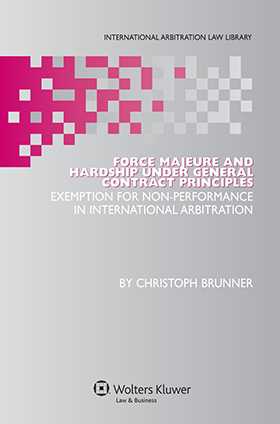
Lawyers involved in international commercial transactions know well that unforeseen events affecting the performance of a party often arise. Not surprisingly, exemptions for non-performance are dealt with in a significant number of arbitral awards. This very useful book thoroughly analyzes contemporary approaches, particularly as manifested in case law, to the scope and content of the principles of exemption for non-performance which are commonly referred to as ‘force majeure’ and ‘hardship.’ The author shows that the ‘general principles of law’ approach addresses this concern most effectively.
Generally accepted and understood by the business world at large, this approach encompasses principles of international commercial contracts derived from a variety of legal systems. Its most important ‘restatements’ are found in the 1980 United Nations Convention on Contracts for the International Sale of Goods (CISG) and the UNIDROIT Principles of International Commercial Contracts (UPICC).
Establishing specific standards and “case groups” for the exemptions under review, the analysis treats such recurring elements as the following:
The book is a major contribution to the development of the use of general principles of law in international commercial arbitration. It may be used as a comprehensive commentary on the force majeure and hardship provisions of the UPICC, as well as on Art. 79 of the CISG. In addition, as an insightful investigation into the fundamental question of the limits of the principle of sanctity of contracts, this book is sure to capture the attention of business lawyers and interested academics everywhere.
Chapter 1. Introduction. § 1. Force Majeure and Hardship in
International Commercial Transactions. § 2. General Principles of
Commercial Contracts: Methodological Approach.
Chapter 2. Scope of Application of
General Contract Principles. § 3. General Remarks on the Governing
Law and the Application of General Contract Principles. § 4.
Choice of Law Agreement Providing for the Application of a National Law. §
5. No Choice of Law Made by the Parties.
Chapter 3. The Concept of Non-performance. § 6. The Concept of
Non-Performance under General Contract Principles. Chapter 4.
Force Majeure Excuse.§ 7.The Force Majeure Excuse as a General
Principle of Law. § 8. Individual Requirements of the Force
Majeure Excuse under General Contract Principles. § 9. Legal
Effects of the Force Majeure Excuse. § 10. Interpretation and
Effects of Force Majeure Clauses.
Chapter 5. Hardship (Change
of Circumstances): Fundamental Change of the Equilibrium of the Contract. §
11. Hardship as a General Principle of Law. § 12. Individual
Requirements of the Hardship Defence. § 13. Legal Effects of
Hardship. § 14. Interpretation and Legal Effects of Hardship
Clauses. § 15. Hardship Distinguished from Other Remedies.
Chapter 6.
Conclusion.
Bibliography,
Principles on Force Majeure in the
CISG, UPICC,PECL, the TLDB-Principles and ICC Force Majeure Clause 2003,
Principles on Hardship in the UPICC, PECL, the TLDB-Principles and ICC
Hardship Clause 2003, Index
 NEED HELP FINDING THE RIGHT SOLUTION?
Call sales at 1-800-638-8437
HAVE A QUESTION?


These cookies are necessary for the website to function. They are usually set in response to actions made by you which amount to a request for services, such as setting your privacy preferences, logging in or filling in forms. You can set your browser to block or alert you about these cookies, this may have an effect on the proper functioning of (parts of) the site.
These cookies enable the website to provide enhanced functionality, user experience and personalization, and may be set by us or by third party providers whose services we have added to our pages. If you do not allow these cookies, then some or all of these services may not function properly.
These cookies support analytic services that measure and improve the performance of our site. They help us know which pages are the most and least popular and see how visitors move around the site.
These cookies may collect insights to issue personalized content and advertising on our own and other websites, and may be set through our site by third party providers. If you do not allow these cookies, you may still see basic advertising on your browser that is generic and not based on your interests.
