Product Line | Kluwer Law International |
|---|---|
ISBN-13 | 9789403535869 |
Availability | Ships in 5-7 Business Days |
Last Updated | 2023-07-13 |
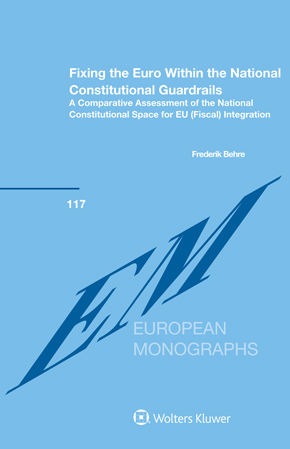
Fixing the Euro within the National Constitutional Guardrails is a groundbreaking book furnishing a structured, comparative overview and outlook on how the available national constitutional space can be adapted to the political aspirations aiming at implementing EU fiscal integration steps while, at the same time, effectively protecting the national constitutional values at stake. EU fiscal integration is indispensable to establishing a stable single currency in the long run. However, this integration is proving ever more difficult in light of increasing national constitutional opposition. The author of this innovative book shows that this dilemma between EU fiscal integration and national constitutional limits can be refuted.
What’s in this book:
Based on a broad comparative assessment of Finland and Germany – two countries which have comprehensively dealt with Eurocrisis issues in largely contrasting constitutional ways – and a detailed comparative assessment of the specific French, German, Polish, and Spanish constitutional (identity) limits, this book tests EU fiscal integration steps against the charted national constitutional space to determine their attainability. The resulting overview enumerates best practices that can be employed to locate constitutional space for EU fiscal integration while enhancing the protection of core constitutional principles. The analysis tackles the following specific areas:
From start to finish, the analysis elucidates the vital role EU integration plays in stabilizing core national constitutional values in light of such complex challenges as the COVID-19 pandemic, the current Russian war of aggression against Ukraine and the required common defence strategies but also climate change and digitalisation.
How this will help you:
In its innovative response to the urgent challenge of feasible EMU reforms to stabilize the euro, this book reveals how national constitutional systems can address EU (fiscal) integration in a more flexible and yet more effective manner, how EU integration steps can engage with national constitutional concerns in a more structured manner, as well as specifically how national parliaments can be integrated and can play a decisive role even when budgetary and fiscal powers are conferred at the EU level, thereby identifying a future model for EU cooperation in politically important competence areas. It thus offers a constructive outlook on achievable fiscal integration steps which will prove of inestimable value to lawyers, judges, and policymakers at the national and EU levels.
Preface
Acknowledgements
CHAPTER 1
Introduction
PART I
Charting the National Constitutional Space
SECTION I
Macro-comparative Assessment of Finland and Germany
CHAPTER 2
Macro-comparative Assessment of Finland
CHAPTER 3
Macro-comparative Assessment of Germany
CHAPTER 4
Comparative Conclusions on Finland and Germany
SECTION II
Micro-comparative Assessment of Selected National Material Limits to EU Fiscal Integration
CHAPTER 5
Micro-comparative Assessment of French, German, Polish and Spanish Limit to EU Fiscal Integration
CHAPTER 6
Comparing the Different National Constitutional Identity Limits and Their Implications for EU Fiscal Integration Proposals
PART II
Testing the Charted National Constitutional Space
CHAPTER 7
Deconstructing EU Fiscal Integration Proposals
CHAPTER 8
The Compatibility of EU Fiscal Integration Proposals with National Constitutional Concerns
CHAPTER 9
Overall Conclusions and Outlook
Bibliography
Table of Constitutional Decisions and Case-Law
Index
 NEED HELP FINDING THE RIGHT SOLUTION?
Call sales at 1-800-638-8437
HAVE A QUESTION?


These cookies are necessary for the website to function. They are usually set in response to actions made by you which amount to a request for services, such as setting your privacy preferences, logging in or filling in forms. You can set your browser to block or alert you about these cookies, this may have an effect on the proper functioning of (parts of) the site.
These cookies enable the website to provide enhanced functionality, user experience and personalization, and may be set by us or by third party providers whose services we have added to our pages. If you do not allow these cookies, then some or all of these services may not function properly.
These cookies support analytic services that measure and improve the performance of our site. They help us know which pages are the most and least popular and see how visitors move around the site.
These cookies may collect insights to issue personalized content and advertising on our own and other websites, and may be set through our site by third party providers. If you do not allow these cookies, you may still see basic advertising on your browser that is generic and not based on your interests.
