.png)
These cookies are necessary for the website to function. They are usually set in response to actions made by you which amount to a request for services, such as setting your privacy preferences, logging in or filling in forms. You can set your browser to block or alert you about these cookies, this may have an effect on the proper functioning of (parts of) the site.
These cookies enable the website to provide enhanced functionality, user experience and personalization, and may be set by us or by third party providers whose services we have added to our pages. If you do not allow these cookies, then some or all of these services may not function properly.
These cookies support analytic services that measure and improve the performance of our site. They help us know which pages are the most and least popular and see how visitors move around the site.
These cookies may collect insights to issue personalized content and advertising on our own and other websites, and may be set through our site by third party providers. If you do not allow these cookies, you may still see basic advertising on your browser that is generic and not based on your interests.

Product Line | Kluwer Law International |
|---|---|
Product SKU | 10059128-0001 |
ISBN-13 | 9789041125736 |
Availability | Ships in 3-5 Business Days |
Last Updated | 2006-11-27 |
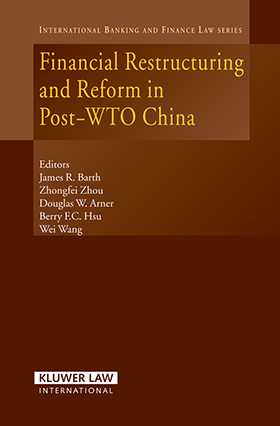
This book addresses the on-going process of financial restructuring and reform in post-WTO China from a legal perspective. Chapter 1 provides an overview of the impact of the WTO on China’s financial markets and financial law systems. Chapter 2 discusses reform of banking law and regulation in post-WTO China. Chapter 3 addresses the role of the central bank in China’s financial system, focusing on issues of independence and accountability of the People’s Banking of China (PBOC), China’s central bank. Chapter 4 analyses China’s compliance with WTO obligations in the area of banking. Chapter 5 discusses the role of asset management companies (AMCs) in China’s on-going banking restructuring and liberalization. Chapter 6 analyses the development of securities markets in China, the challenges being faced and the impact of the WTO. Chapter 7 describes insurance and its development in China, focusing on the role of the WTO in liberalization. A new topic in China, i.e., financial conglomerates, is discussed in chapter 8, building upon the discussions in the previous chapters. Chapter 9 in turn studies the issue of financial institution insolvency and restructuring as noted in previous chapters, key issues in China. Chapter 10 discusses the double impact of the WTO and one of China’s regional trade agreements, CEPA, on China’s banking law.
Call sales at 1-800-638-8437