Product Line | Kluwer Law International |
|---|---|
ISBN-13 | 9789403544090 |
Availability | Ships in 5-7 Business Days |
Last Updated | 2026-04-21 |
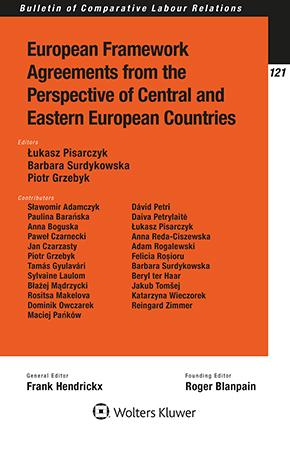
BULLETIN OF COMPARATIVE LABOUR RELATIONS - 121
European Framework Agreements from the Perspective of Central and Eastern European Countries is a book in which a group of labour law experts from the Central and Eastern European Countries (CEECs) thoroughly investigates the labour-related challenges arising due to the limited collective bargaining coverage and/or lower employment standards that characterise the region and have shaped a labour relations environment different from that of Western Europe. European transnational company agreements (TCAs) – designed to ensure appropriate employment conditions within the entire business group, including subsidiary companies – are often perceived as opportunities to promote social dialogue.
What’s in this book:
The overall approach is twofold: relevant literature and court decisions are taken into account, but a major strength of the endeavour derives from in-depth personal interviews with trade unionists, representatives of employers’ organisations, and European Works Council delegates. Building on this rich foundation, the contributors examine such factors as the following:
How this will help you:
Recognising that European labour law and social policy have entered a new phase in the past decade, the contributors present the role of TCAs as a significant element in a broader transformation of labour relations. Unions, employers, policymakers, practitioners, and academics concerned with labour and employment law will welcome not only the contributors’ critical diagnosis and practical policy-relevant guidance but also their recognition that TCAs can serve as laboratories of transnational labour solidarity.
This book was created as a result of research project no. 2019/33/B/HS5/02067, financed by the National Science Centre (Narodowe Centrum Nauki).
Notes on Contributors
Acknowledgements
Introduction
Piotr Grzebyk, Lukasz Pisarczyk & Barbara Surdykowska
PART I
The West in Search of the East: Collective Bargaining Promotion and Transnational Collective Agreements
CHAPTER 1
The Ebb and Flow of European Support for Social Dialogue
Sylvaine Laulom
CHAPTER 2
The Legal Framework of Transnational Collective Agreements: Current State and Future Perspective
Anna Boguska, Lukasz Pisarczyk, Beryl ter Haar & Katarzyna Wieczorek
CHAPTER 3
The Development of Collective Bargaining in Central and Eastern Europe
Rositsa Makelova, Jakub Tomšej, Tamás Gyulavári, Dávid Petri, Daiva Petrylaite, Blazej Madrzycki, Lukasz Pisarczyk & Felicia Ro¿ioru
CHAPTER 4
Private International Law Perspectives on Transnational Company Agreements (TCAs) under Rome I Regulation
Piotr Grzebyk
CHAPTER 5
The Legal Status of TCAs in Poland
Anna Boguska
PART II
The East Does Not Meet the West or Why the Idea of Transnational Collective Negotiations Failed
CHAPTER 6
East Does Not Meet West: How Various Approaches to TCAs Reflect Divergent Perspectives on Industrial Relations in the ‘Old’ and ‘New’ EU
Jan Czarzasty
CHAPTER 7
Transnational Collective Agreements: The Troubled Child of Global and European Trade Union Federations
Jan Czarzasty & Barbara Surdykowska
CHAPTER 8
The Issue of ‘Dark Matter’ or the Psychosis of ‘Social Dumping’ as an Explanation for EU Trade Unions’ Problems with the Idea of TCAs
Slawomir Adamczyk
CHAPTER 9
Adopting and Implementing European Collective Agreements in Central and Eastern European Countries
Lukasz Pisarczyk & Barbara Surdykowska
PART III
Isn’t It over Yet? The Potential of Cross-Border Negotiations in a Changing World of Work
CHAPTER 10
From Symbolic Gestures to Binding Standards: Analysis of Equality Provisions in Transnational Company Agreements
Jakub Tomšej
CHAPTER 11
From Words to Action: Advancing OSH in Transnational Company Agreements
Paulina Baranska
CHAPTER 12
Effective Implementation of International Framework Agreements
Reingard Zimmer
CHAPTER 13
European Public Service Trade Unions’ Perspective on Transnational Company Agreements
Adam Rogalewski
CHAPTER 14
TCAs and the Enforcement of Workers’ Rights in Supply Chains
Pawel Czarnecki
CHAPTER 15
Strikes and TCAs: Some Futuristic Remarks
Barbara Surdykowska
CHAPTER 16
Transnational Restructuring and the Democratic Deficit: A Critical Look at Workers’ Rights to Information, Consultation and Participation in Selected European Countries
Dominik Owczarek & Maciej Panków
CHAPTER 17
The Role of Codes of Conduct in Multinational Companies
Anna Reda-Ciszewska
 NEED HELP FINDING THE RIGHT SOLUTION?
Call sales at 1-800-638-8437
HAVE A QUESTION?


These cookies are necessary for the website to function. They are usually set in response to actions made by you which amount to a request for services, such as setting your privacy preferences, logging in or filling in forms. You can set your browser to block or alert you about these cookies, this may have an effect on the proper functioning of (parts of) the site.
These cookies enable the website to provide enhanced functionality, user experience and personalization, and may be set by us or by third party providers whose services we have added to our pages. If you do not allow these cookies, then some or all of these services may not function properly.
These cookies support analytic services that measure and improve the performance of our site. They help us know which pages are the most and least popular and see how visitors move around the site.
These cookies may collect insights to issue personalized content and advertising on our own and other websites, and may be set through our site by third party providers. If you do not allow these cookies, you may still see basic advertising on your browser that is generic and not based on your interests.
