
Philipp Werner
Jones Day
Rechtsanwalt
Rechtsanwalt
Philipp Werner is a Rechtsanwalt and Partner in Jones Day’s Brussels Office.
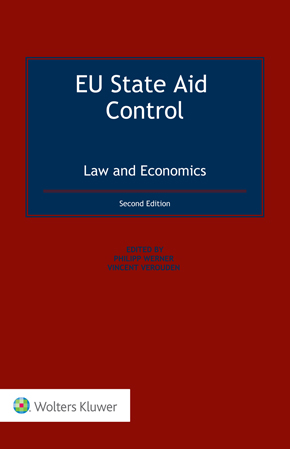
EU State Aid Control, currently in its second edition, is an in-depth analysis of the legal and economic principles of EU State aid control, thoroughly exploring the central rationales of State aid and the various trade-offs that underlie the rules and decisions taken by the Commission and the Courts. When the first edition of EU State Aid Control – Law and Economics was published eight years ago, it was a first-of-its-kind book.
Since then, the world has seen a great deal of developments that seemed to be a thing of the past: Brexit, the COVID-19 pandemic, and Russia’s invasion of Ukraine. European politics and the law of the European Union have had to adapt to these challenges and changes, and EU State aid law has been no exception. In recent years, the European Commission has reviewed and adapted the General Block Exemption Regulation (GBER), as well as its Guidelines and communications covering practically all areas of State aid control. New rules have also sprouted, such as the EU/UK Trade and Cooperation Agreement, a new set of crisis rules in the wake of the COVID-19 pandemic, the Foreign Subsidies Regulation, and the Temporary Crisis and Transition Framework, which are all profoundly influencing, expanding, and modifying State aid control law and practice in the EU. Concurrently, the European Courts have shaped State aid law through several significant judgments.
What’s in this book:
The current edition of this book reflects these developments and their legal and economic implications. It has been thoroughly revised, updated and expanded. New chapters include:
How this will help you:
As a critical assessment of the current status of EU State aid control from both legal and economic perspectives and as an authoritative guide through its complexities and pitfalls, this book will be highly appreciated, now and in the years to come, by all stakeholders required to understand, interpret and apply the State aid rules.
Editors:
Philipp Werner & Vincent Verouden
Editors
Contributors
Editorial
Philipp Werner & Vincent Verouden
CHAPTER 1
Introduction: The Law and Economics of EU State Aid Control
Vincent Verouden & Philipp Werner
PART I
The Notion of State Aid
CHAPTER 2
Advantage
Giuseppe Conte & Mohammed Khalil
CHAPTER 3
State Measure
Antonios Bouchagiar
CHAPTER 4
Selectivity
Michael Honoré
CHAPTER 5
Distortion of Competition and Effect on Trade
Jacques Derenne & Laurent Eymard
CHAPTER 6
State Aid Control Beyond the EU: Legal Convergence and Unilateral Expansion
Pablo Ibánez Colomo & Damien Neven
PART II
Compatibility of State Aid
CHAPTER 7
Compatibility of State Aid with the Internal Market
Leigh Hancher & Phedon Nicolaides
CHAPTER 8
The General Block Exemption Regulation
Koert van Buiren & Alexander Rose
CHAPTER 9
Ex Post Evaluation of Aid
Xavier Boutin, Zsolt Udvari & Daniele Vidoni
CHAPTER 10
Research, Development and Innovation Aid, IPCEI
Jan Bonhage & Otto Toivanen
CHAPTER 11
Regional Aid
Hans W. Friederiszick, Elzbieta Glowicka & Massimo Merola
CHAPTER 12
Risk Finance Aid
Isabel Taylor, Albert Bravo-Biosca & Michael Troege
CHAPTER 13
Rescue and Restructuring Aid
Ulrich Soltész & Frank Maier-Rigaud
CHAPTER 14
Services of General Economic Interest
Cees Dekker & Vincent Verouden
CHAPTER 15
State Aid in Times of Crisis: Temporary Frameworks and the Boundaries of State Aid Policy
Alfonso Lamadrid de Pablo, Virginia Romero Algarra & Adina Claici
PART III
State Aid in Specific Sectors
CHAPTER 16
Infrastructure Aid
Ida Rødseth & Till Müller-Ibold
CHAPTER 17
State Aid in the Broadband Sector
Hein Hobbelen, Oliver Stehmann & Baptist Vleeshouwers
CHAPTER 18
State Aid in the Postal Services Sector
Alessandra Fratini & Marc Chovino
CHAPTER 19
Law and Economics of State Aid Control in the Aviation Sector
François-Charles Laprévote, Nicole Robins & David Pérez de Lamo
CHAPTER 20
Aid to the Railway Sector
Udo Woll & Fabrizio Spargoli
CHAPTER 21
Climate, Environmental Protection and Energy Aid
Lluís Saurí Romero & Kai Struckmann
CHAPTER 22
Aid to Broadcasting, Culture and Sports
Christine Gerlach, Hannah Schauf & Caroline Buts
CHAPTER 23
Aid in the Banking Sector
Athena Kontosakou, Dimitrios Magos & Stephen Mavroghenis
CHAPTER 24
State Aid and Privatisation
Andreas von Bonin, Florian Reiter-Werzin & Sean Ennis
PART IV
Procedural Aspects
CHAPTER 25
State Aid Procedure
Max Klasse
CHAPTER 26
Private Enforcement under State Aid Law in Light of Its Effective Role in Competition Law
Adam Scott
Index
The book, now in its second edition, is a major addition to the literature, both academic and practice-oriented. Philipp Werner, a lawyer, and Vincent Verouden, an economist, have once again put together an impressive array of lawyers and economists, true experts in the field, to provide a deep analysis of virtually all substantive and procedural aspects of State aid. The resulting book counts 26 chapters divided into four parts (respectively and understandably, on the notion of aid, its compatibility, specific sectors and procedure) in more than 1,300 pages of work! As compared to the previous edition, five new chapters have been introduced. While the old chapter on transport has been divided into two separate chapters (one on aviation, the other on land transport), brand new analysis on State aid control beyond the EU, State aid in times of crisis, procedure and private enforcement have all warranted a specific chapter each.
Let me immediately say that this book is very much welcome and may prove to be a pivotal aide to navigate the difficult waters of our time and the impressive body of principles of law of State aid. The review will try and develop this point by concentrating on the specific features of the book and juxtaposing them to the various challenges that the EU and EU State aid control are now facing. —Luca Rubini, European State Aid Law Quarterly, Volume 24, Issue 3 (2025)

 NEED HELP FINDING THE RIGHT SOLUTION?
HAVE A QUESTION?


