Product Line | Kluwer Law International |
|---|---|
Product SKU | 10073143-0001 |
ISBN-13 | 9789403514529 |
Availability | Ships in 5-7 Business Days |
Last Updated | 2019-09-17 |
Bulletin of Comparative Law and Labour Relations
About this book:
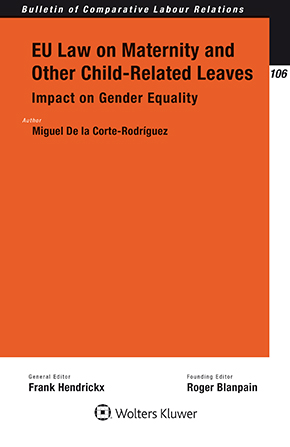
EU Law on Maternity and Other Child-Related Leaves aims to put on the table the limitations and side effects of the current EU legislative framework on maternity leave. The current system is focused on the biological differences of women related to maternity. Although proven effective in protecting pregnancy, giving birth and breastfeeding – that is, the biological differences of women related to maternity – the current EU legislative framework on maternity leave tends to overlook the roles of both parents, especially during the post-delivery period of ‘bonding’ with the child. This framework, along with EU law on parental leave, which does not encourage an equal take-up of the leave, gives rise to serious issues of gender equality affecting both men and women. This deeply researched and urgent book proposes alternative options for future EU law on child-related leave that can be applied to both employees and self-employed workers to mitigate these limitations and side effects.
What’s in this book:
Analysing comprehensively the various EU Directives which, directly or indirectly, relate to maternity leave, paternity leave, adoption leave and parental leave, as well as the corresponding case law of the Court of Justice of the EU, the author uses a social-risk approach and tackles the following issues:
The research focuses on working parents (including non-delivering parents in same-sex couples or adoption) and includes a comparative analysis of the law of six countries – Belgium, Ireland, Spain, the United Kingdom, Sweden and Portugal – chosen to illustrate the variety of national schemes available and how their desirable features can be introduced into EU law.
How this will help you:
A more balanced design of child-related leave is a must in today’s society for reasons of fairness and also for economic considerations. This complete analysis of EU legislation and case law about child-related leave – including the first-ever systematic and in-depth analysis on whether maternity leave can be considered discriminatory against fathers and a review of economic literature on how child-related leave affects the situation of women in the labour market – offers forward-looking solutions for child-related leave to enhance gender equality. Practitioners and non-governmental organisations dealing with EU and national matters related to labour and employment law, social security law and gender equality law will welcome this important book, as will academics and policymakers interested in maternity and other child-related leaves.
Notes on Author
List of Abbreviations
Acknowledgements
Introduction
CHAPTER 1
EU Legislative Framework on Maternity Leave
CHAPTER 2
Social Risk Approach in the EU Directives on Maternity Leave: A Consistency Analysis
CHAPTER 3
Maternity Leave and Effects for Women in the Labour Market
CHAPTER 4
Maternity Leave and Discrimination Against Non-delivering Parents
CHAPTER 5
Conclusions
Bibliography
Table of Cases & Opinions
Table of Legislation
Official Documents
 NEED HELP FINDING THE RIGHT SOLUTION?
Call sales at 1-800-638-8437
HAVE A QUESTION?


These cookies are necessary for the website to function. They are usually set in response to actions made by you which amount to a request for services, such as setting your privacy preferences, logging in or filling in forms. You can set your browser to block or alert you about these cookies, this may have an effect on the proper functioning of (parts of) the site.
These cookies enable the website to provide enhanced functionality, user experience and personalization, and may be set by us or by third party providers whose services we have added to our pages. If you do not allow these cookies, then some or all of these services may not function properly.
These cookies support analytic services that measure and improve the performance of our site. They help us know which pages are the most and least popular and see how visitors move around the site.
These cookies may collect insights to issue personalized content and advertising on our own and other websites, and may be set through our site by third party providers. If you do not allow these cookies, you may still see basic advertising on your browser that is generic and not based on your interests.
