Product Line | Wolters Kluwer Legal & Regulatory U.S. |
|---|---|
Product SKU | 10073218 |
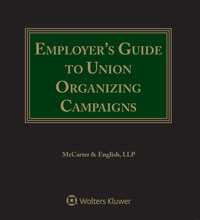
The Employer's Guide to Union Organizing Campaigns provides employers and practitioners with how-to practical guidance on anticipating—and reacting to—union activity while staying in compliance with applicable laws. This publication provides employers with proven insights into becoming proactive employers who create work environments where employees are treated fairly—establishing the sort of win-win conditions in which union organizing techniques have less effect.
Note: Online subscriptions are for three-month periods.
About the Authors
Foreword
Acknowledgments
Chapter 1 Overview: Labor–Management Relations: Yesterday and Today
§1.01 Where did all the unions go? And are they coming back?
§1.02 Board elections: Resurgence or irrelevance?
§1.03 The corporate campaign: The challenge continues
§1.04 Why do employers care about unionization?
§1.05 About “The Employer's Guide”
Chapter 2 Employment in the 21st Century
§2.01 A changing workplace
§2.02 A changing workforce
§2.03 An evolving culture of work
§2.04 The political landscape
§2.05 Enduring organizing efforts
Chapter 3 The Low-Risk Employer
§3.01 The low risk employer
§3.02 The preventive self-audit: An essential exercise
§3.03 Staying conflict-free
§3.04 Employee communications programs
§3.05 Ensuring compliance
§3.06 Corporate labor relations strategy
Chapter 4 Elements of Effective Employee Relations
§4.01 The corporate culture
§4.02 Work rules
§4.03 The employee handbook
§4.04 Employee participation programs
§4.05 Progressive discipline
§4.06 Resolving employee complaints
§4.07 Alternative dispute resolution programs
§4.08 Supervisory and managerial training
§4.09 Illustrations 1–4
Chapter 5 Anticipating a Union Campaign
§5.01 Assessing your vulnerability
§5.02 Expressing opposition to a union
§5.03 Manager training on the law of organizing
§5.04 Bargaining unit vulnerability analysis
§5.05 Recognizing the early warning signs
§5.06 Preempting the union's message
Chapter 6 Understanding the New Union Movement
§6.01 Introduction
§6.02 The dual-front union movement
§6.03 Change to win and the modern template for organizing: Not always smooth sailing
§6.04 The AFL-CIO embraces the new model
§6.05 Organizing under the new model
§6.06 Embracing new demographics
§6.07 Embracing new models for organizing
§6.08 Embracing new tactics and technologies
§6.09 A national—or global—approach
§6.10 Conclusion
Chapter 7 The Old Model: Enduring Tools for Organizing
§7.01 A foot in the door
§7.02 The organizational meeting
§7.03 Traditional arguments
§7.04 Other organizing techniques
Chapter 8 Contemporary Organizing Techniques
§8.01 Corporate campaigns
§8.02 Industry-wide campaigns
§8.03 Neutrality agreements
§8.04 Voluntary recognition
§8.05 Framework agreements
§8.06 Another word on unlawful recognition
Chapter 9 The Corporate Campaign: What to Expect
§9.01 Introduction
§9.02 Company research and profiling
§9.03 Inside labor pressure
§9.04 Unfair labor practice charges
§9.05 The court of public opinion
§9.06 Legislative initiatives
§9.07 Litigation as weapon
Chapter 10 The Employer Counter-Offensive
§10.01 Introduction
§10.02 Responding to a request for “card check”
§10.03 Questioning union support
§10.04 A campaign, not “interference”
§10.05 Investigate, then educate
§10.06 Educating employees
§10.07 Avoiding unfair labor practices
§10.08 Legal action against union misconduct
§10.09 Strike preparation and response
§10.10 External counter-organizing resources
§10.11 When the dust settles…
Chapter 11 Communicating Your Message
§11.01 Introduction
§11.02 Employer's right to free speech
§11.03 Internal communication strategies
§11.04 The arsenal of communication techniques
§11.05 External communications
Chapter 12 Managing Pro-Union Communication
§12.01 Introduction
§12.02 Implementing valid work rules
§12.03 A lawful no-solicitation rule
§12.04 Solicitation in working areas
§12.05 Distribution of literature
§12.06 Organizing by off-duty employees
§12.07 Other union-related activity
Chapter 13 The Board-Conducted Election
§13.01 Introduction
§13.02 Processing the representation petition
§13.03 Bargaining unit determination
§13.04 Election agreements
§13.05 Employer obligations after directions of election
§13.06 Voter eligibility
§13.07 Mail ballot elections
§13.08 The on-site election
§13.09 Policing the polls
§13.10 Counting the ballots
§13.11 Two-union contests and run-off elections
§13.12 Illustrations 1–2
Chapter 14 Post-Election Proceedings
§14.01 Voter challenges
§14.02 Election objections
§14.03 Procedure for filing objections
§14.04 Board review
§14.05 Decertification petitions
§14.06 The employer's campaign
§14.07 If the union wins
§14.08 Illustration 1
 NEED HELP FINDING THE RIGHT SOLUTION?
Call sales at 1-800-638-8437
HAVE A QUESTION?


These cookies are necessary for the website to function. They are usually set in response to actions made by you which amount to a request for services, such as setting your privacy preferences, logging in or filling in forms. You can set your browser to block or alert you about these cookies, this may have an effect on the proper functioning of (parts of) the site.
These cookies enable the website to provide enhanced functionality, user experience and personalization, and may be set by us or by third party providers whose services we have added to our pages. If you do not allow these cookies, then some or all of these services may not function properly.
These cookies support analytic services that measure and improve the performance of our site. They help us know which pages are the most and least popular and see how visitors move around the site.
These cookies may collect insights to issue personalized content and advertising on our own and other websites, and may be set through our site by third party providers. If you do not allow these cookies, you may still see basic advertising on your browser that is generic and not based on your interests.
