
Frank Hendrickx
Director of the Institute for Labour Law and Full-time Professor
Prof. Dr. Frank Hendrickx is professor of labour law at the Faculty of Law of the University of Leuven (Belgium). He is also part-time professor of European
Bulletin of Comparative Law and Labour Relations
About this book:
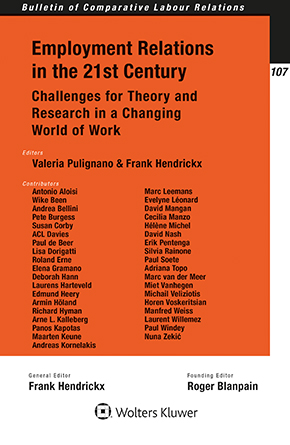
Employment Relations in the 21st Century provides a full and integrated insight into labour law and industrial relations. It cannot be denied that in recent decades, for many, if not most people, work has become unstable and insecure, with serious risk and few benefits for workers. As this reality spills over into political and social life, it is crucial to interrogate the transformations affecting employment relations, shape research agendas, and influence the policies of national and international institutions. This implies to focus on transnational regulatory structures and new forms of social protection and representation for different typologies and forms of work as a way to avoid increasing inequalities across (and within) countries. This volume brings together thirty-nine scholars (both academics and experienced industrial relations actors) in the fields of employment relations and labour law in a forthright discussion of new approaches, theories, and methods aimed at ameliorating the world of work.
What’s in this book:
Focusing on why and how work is changing, how collective actors deal with it, and the future of work from different disciplinary angles and at an international level, the contributors describe and analyse such issues and topics as the following:
Derived from a major conference held in Leuven in September 2018, this book offers a more intensively in-depth understanding of the changing world of work, its main transformations, and the challenges posed to classical employment relation theories and methods as well as to labour law.
How this will help you:
With its wide range of insights, analysis, and reflection, this unique contribution to the study of industrial relations offers an authoritative reference guide to scholars, policymakers, trade unions and business associations, human resources professionals, and practitioners who need to deal with the future of work challenges. Providing up-to-date information and analysis of the most recent key developments in labour law and industrial relations, this book is a unique volume and a fruitful contribution to the interdisciplinary study of industrial relations from the fields of social sciences and law.
Notes on Contributors
Employment Relations in the 21st Century: Introduction and Overview
Valeria Pulignano & Frank Hendrickx
PART I
Why and How Is Work Changing?
CHAPTER 1
Precarious Work, Precarious Lives: Changing Employment Relations in Rich Democracies
Arne L. Kalleberg
CHAPTER 2
Labour Law in Changing Times
ACL Davies
CHAPTER 3
Ford, Taylor and the Gig: Workplaces in Transition
David Mangan
CHAPTER 4
Workers Without Workplaces and Unions Without Unity: Non-standard Forms of Employment, Platform Work and Collective Bargaining
Antonio Aloisi & Elena Gramano
CHAPTER 5
That Is Just Part of Being Able to Do My Cool Job: Understanding Low Earnings but High Job Satisfaction in the Creative Industries in the Netherlands
Wike Been & Maarten Keune
CHAPTER 6
Reforming Labour Laws in the Netherlands: An Assessment of the Redistributive Effects
Nuna Zekic
PART II
How Do Collective Actors Deal with the Changing World of Work? European and National Perspectives
CHAPTER 7
Labour Politics and the EU’s New Economic Governance Regime: Methodological Challenges and Innovations of a New Research Agenda
Roland Erne
CHAPTER 8
‘Liquid’ Unionism and the Future of Industrial Relations
Adriana Topo
CHAPTER 9
Going It Alone? The Involvement of Trade Unions in the Living Wage Campaign in the United Kingdom
Edmund Heery, Deborah Hann & David Nash
CHAPTER 10
The Role of HRM and Trade Unions in the Resolution of Workplace Conflict in Britain
Deborah Hann & David Nash
CHAPTER 11
Interest Representation in Graphic Design and Video Game Development in Italy: Demand, Supply and Influence on Working Conditions
Lisa Dorigatti, Andrea Bellini & Cecilia Manzo
CHAPTER 12
Lay Labour Court Judges as Industrial Relations Actors In Germany, Great Britain and France. Can Field Theory Contribute to Comparative Research?
Pete Burgess, Susan Corby, Armin Höland, Hélène Michel & Laurent Willemez
PART III
The Future of Work: Challenges
CHAPTER 13
Is Forced Labour the New Normal?
Richard Hyman
CHAPTER 14
The Development of Employee Involvement in the EU: Lessons to Be Learned
Manfred Weiss
CHAPTER 15
The Dark Side of the Labour Market: Institutional Change, Economic Crisis and Undeclared Work in Greece
Horen Voskeritsian, Panos Kapotas, Andreas Kornelakis & Michail Veliziotis
CHAPTER 16
Workers’ Involvement in Collective Redundancies in EU Law: What for? A Case Study
Silvia Rainone
CHAPTER 17
Work Incapacity and Disability Coinciding?: The Role International and Supranational Understanding of Disability in Member States’ Labour Law
Miet Vanhegen
PART IV
Industrial Relations in the Low Countries: Belgium and the Netherlands
CHAPTER 18
Social Dialogue in the Low Countries: Institutional Reconversion and Legal Challenges in Belgium and the Netherlands
Valeria Pulignano, Frank Hendrickx & Marc van der Meer
CHAPTER 19
Belgium: Adapt, or Transform?
Evelyne Léonard
CHAPTER 20
Is the Poldermodel Crumbling?
Paul de Beer & Maarten Keune
CHAPTER 21
Contributions from the Social Partners
Paul Windey, Marc Leemans, Paul Soete, Erik Pentenga & Laurens Harteveld
 NEED HELP FINDING THE RIGHT SOLUTION?
HAVE A QUESTION?


