
Professor of Intellectual Property Law

Product Line | Kluwer Law International |
|---|---|
Product SKU | 10058959-0001 |
ISBN-13 | 9789041136695 |
Availability | Ships in 3-5 Business Days |
Last Updated | 2012-08-14 |
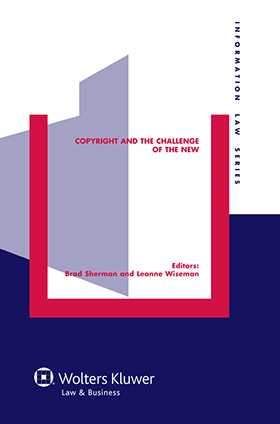
Copyright is not, as is often thought, something that is periodically ‘extended’ to cover a new field or medium; rather, copyright redefines itself whenever its efficacy is challenged. While many factors have contributed to this process, the most consistent has been the challenges created by new technologies. The contributing authors build upon this insight to show that copyright law is, and has always been, a creature of technology. Each chapter focuses on a specific technology or group of technologies – photography, telegraphy, the phonogram, radio, film, the photocopier, the tape player, television, and computer programs – emphasizing the changes that each technology instigated and the challenges and opportunities it created.
Perhaps the most profound insight of this extraordinary book is the authors’ claim – ably supported in a series of intriguing chapters – that the way the law responds and reacts to new technologies is always mediated by the political, social, economic, and cultural environment in which the interaction occurs. For example, these chapters describe and explain how:
As well as providing insight into the ways that copyright law interacted with old technologies when they were new, the book also offers important insights into problems and issues currently confronting copyright law and policy such as the appropriate scope of copyright and the relation between copyright and the public interest. With the broad perspectives opened by these essays, academics, practitioners and policymakers in the field will find themselves well equipped to deal with the problems that will inevitably be created by technologies in the future.
Chapter 1. Copyright, When Old Technologies Were New; B. Sherman, L. Wiseman.
Chapter 2. The World Daguerreotyped – ‘What a Spectacle!’ Copyright Law, Photography and the Economic Mission of Empire; K. Bowrey.
Chapter 3. The Electric Telegraph and the Struggle over Copyright in News in Australia, Great Britain and India; L. Bently.
Chapter 4. The Phonogram: A Tale of Vested Interests and Seized Opportunities; J. Okpaluba.
Chapter 5. Radio: Early Battles over the Public Performance Right; G. Austin.
Chapter 6 . How Did Film Become Property? Copyright and the Early American Film Industry; O. Bracha.
Chapter 7. The Story of the Tape Recorder and the History of Copyright Levies; B. Hugenholtz.
Chapter 8. Making Copies: Photocopying and Copyright; L. Wiseman.
Chapter 9. Public Ownership of Private Spectacles: Copyright and Television; B. Sherman.
Chapter 10. A Square Peg in a Round Hole? Copyright Protection for Computer Programs; P. Samuelson.
Call sales at 1-800-638-8437
.png)
These cookies are necessary for the website to function. They are usually set in response to actions made by you which amount to a request for services, such as setting your privacy preferences, logging in or filling in forms. You can set your browser to block or alert you about these cookies, this may have an effect on the proper functioning of (parts of) the site.
These cookies enable the website to provide enhanced functionality, user experience and personalization, and may be set by us or by third party providers whose services we have added to our pages. If you do not allow these cookies, then some or all of these services may not function properly.
These cookies support analytic services that measure and improve the performance of our site. They help us know which pages are the most and least popular and see how visitors move around the site.
These cookies may collect insights to issue personalized content and advertising on our own and other websites, and may be set through our site by third party providers. If you do not allow these cookies, you may still see basic advertising on your browser that is generic and not based on your interests.
