Product Line | Kluwer Law International |
|---|---|
ISBN-13 | 9789403506289 |
Availability | Ships in 5-7 Business Days |
Last Updated | 2024-12-19 |
Bulletin of Comparative Law and Labour Relations # 99
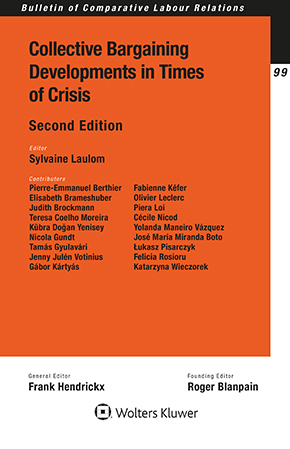
Collective Bargaining Developments in Times of Crisis, currently in its second edition, is an update of the research published in 2018 analysing the evolutions of collective bargaining in the times of crises of unprecedented magnitude that have hit all countries: the totally unexpected COVID-19 pandemic with its massive consequences, the energy crisis, the environmental crisis, and the Ukrainian war crisis followed by inflation. However, an essential and monumental change has taken place at the European level in this area since the first edition in 2018, which can be described as a paradigm shift. The adoption of the Directive on Adequate Minimum Wages marks a true break with the post-financial crisis period, as the EU is now focusing on the development and enhancement of strong sectoral collective bargaining systems in wage settings.
What’s in this book:
The book is organised into two building blocks:
How this will help you:
As in the first edition, the book takes stock of the current state of collective bargaining in Europe. It is a crucial study for labour and employment law practitioners and an exemplary analysis of immeasurable value to policymakers and academics in the field.
Notes on Contributors
Introduction from the First Edition to the Second One
Sylvaine Laulom
PART I
Comparative Perspectives
CHAPTER 1
From Decentralisation of Collective Bargaining to Re-centralisation of Industrial Relations Systems?
Sylvaine Laulom
CHAPTER 2
Chasing the Holy Grail? Stumbling Collective Bargaining in Eastern Europe and the Hungarian Experiment
Tamás Gyulavári
CHAPTER 3
The Function of Sectoral Collective Agreements and the Risk Approach
Piera Loi
CHAPTER 4
Incentivising Collective Bargaining
Pierre-Emmanuel Berthier & Olivier Leclerc
CHAPTER 5
Negotiating Working Time in Times of Crisis and Twin Transition
Nicola Gundt, Lukasz Pisarczyk & Katarzyna Wieczorek
CHAPTER 6
Older Employees, Extended Working Lives, and Collective Bargaining
Jenny Julén Votinius
CHAPTER 7
Collective Bargaining with Regard to Young Employees: Importance and Challenges
Judith Brockmann
CHAPTER 8
Multi-employer Situations and Collective Bargaining: The Hungarian Cases
Gábor Kártyás
CHAPTER 9
Enhancing Working Conditions for Platform Workers Through Social Dialogue: The French Example
Cécile Nicod
PART II
National Perspectives
CHAPTER 10
The Continuous Importance of Sectoral Collective Bargaining in Austria
Elisabeth Brameshuber
CHAPTER 11
Wage Moderation Measures in Times of Crisis: The Belgian Example
Fabienne Kéfer
CHAPTER 12
Is a Revival of Collective Bargaining Possible? Polish Way from Neoliberalism to the Welfare State
Lukasz Pisarczyk
CHAPTER 13
The Revival of Sectoral Collective Bargaining: The Portuguese Experience
Teresa Coelho Moreira
CHAPTER 14
Collective Bargaining in Romania: The Aftermath of an Earthquake – A Fresh Start for Social Dialogue?
Felicia Rosioru
CHAPTER 15
Collective Bargaining in Spain: The Road Goes Ever On
Yolanda Maneiro Vázquez & José María Miranda Boto
CHAPTER 16
A Retrospective Look at Turkish Decentralized Collective Bargaining: A Solution to Various Crisis?
Kübra Dogan Yenisey
 NEED HELP FINDING THE RIGHT SOLUTION?
Call sales at 1-800-638-8437
HAVE A QUESTION?


These cookies are necessary for the website to function. They are usually set in response to actions made by you which amount to a request for services, such as setting your privacy preferences, logging in or filling in forms. You can set your browser to block or alert you about these cookies, this may have an effect on the proper functioning of (parts of) the site.
These cookies enable the website to provide enhanced functionality, user experience and personalization, and may be set by us or by third party providers whose services we have added to our pages. If you do not allow these cookies, then some or all of these services may not function properly.
These cookies support analytic services that measure and improve the performance of our site. They help us know which pages are the most and least popular and see how visitors move around the site.
These cookies may collect insights to issue personalized content and advertising on our own and other websites, and may be set through our site by third party providers. If you do not allow these cookies, you may still see basic advertising on your browser that is generic and not based on your interests.
