Product Line | Kluwer Law International |
|---|---|
Product SKU | 10091698-0001 |
ISBN-13 | 9789403537245 |
Availability | Ships in 5-7 Business Days |
Last Updated | 2023-01-1 |
About this book:
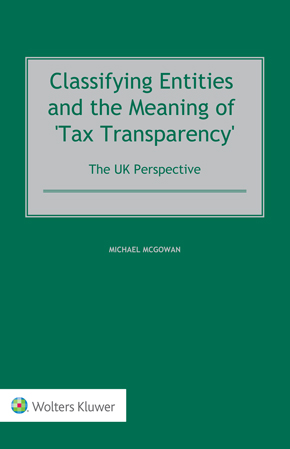
Classifying Entities and the Meaning of ‘Tax Transparency’ breaks new ground in explaining comprehensively the rules for classifying entities and the meaning of ‘tax transparency’ in UK tax law. Imposing UK tax on an entity or those linked to it involves understanding what kind of entity is being dealt with, especially when it is formed outside the UK. Is it a company, a partnership, a trust or something else? This often involves considering whether the entity is ‘tax transparent’ and, if so, what that means. The UK tax rules for classifying entities are notoriously vague, and there is no single UK meaning of ‘tax transparency’.
What’s in this book:
With an emphasis on UK tax law but with a strong international perspective, this book addresses in particular:
The book compares the UK entity classification approach with that of the US, the Netherlands and France. Appendices consider the unusual UK capital gains tax treatment of partnerships, as well as the special transparency rules which can apply where a partnership is a party to loans or derivative contracts, or owns intangible assets.
How this will help you:
Questions of entity classification and tax transparency are of fundamental importance in any mature tax system and especially in a globalised economy. This pragmatic book unlocks those questions for both academics and practitioners, both within and outside the UK.
About the Author
Foreword
Preface
CHAPTER 1
Introduction
CHAPTER 2
The Current UK Approach to Classifying Entities and Establishing Whether They Are ‘Transparent’
CHAPTER 3
The Law Following Anson
CHAPTER 4
Defining Trusts and Deciding When They Are ‘Transparent’ for UK Tax Purposes
CHAPTER 5
The Wider Concept of ‘Tax Transparency’ and Its Meaning in Other Areas of UK Tax Law
CHAPTER 6
The UK Classification of Entities and ‘Tax Transparency’ Issues in Relation to Double Tax Treaties and EU Law
CHAPTER 7
Entity Classification in the US and the Netherlands
CHAPTER 8
Conclusion
APPENDIX A
UK Capital Gains Tax ‘Transparency’ of Partnerships and Its Implications
APPENDIX B
UK Corporation Tax ‘Transparency’ where Partnerships hold Loan Relationships, Derivative Contracts or Intangible Fixed Assets
Bibliography
Table of Cases (UK, England and Wales Unless Stated Otherwise)
Table of Statutory Provisions (UK Unless Stated Otherwise), EU Directives and Regulations, Tax Treaties and Related Documents
Index
‘McGowan's book is both ambitious and revealing. Indeed, it does not only put on evidence the complexities associated with the rule for classifying entities for tax purposes in the UK, but also attempts to address a much deeper and sometimes avoided problem, namely the meaning of 'tax transparency'. As such, the reading of this book is a very interesting and intellectually stimulating exercise.
This book’s contribution and importance are undoubted, especially in times when the international tax community has agreed to target specific transactions involving hybrid and reserve hybrid entities.’
—Leopoldo Parada - British Tax Review issue 5-2023
 NEED HELP FINDING THE RIGHT SOLUTION?
Call sales at 1-800-638-8437
HAVE A QUESTION?


These cookies are necessary for the website to function. They are usually set in response to actions made by you which amount to a request for services, such as setting your privacy preferences, logging in or filling in forms. You can set your browser to block or alert you about these cookies, this may have an effect on the proper functioning of (parts of) the site.
These cookies enable the website to provide enhanced functionality, user experience and personalization, and may be set by us or by third party providers whose services we have added to our pages. If you do not allow these cookies, then some or all of these services may not function properly.
These cookies support analytic services that measure and improve the performance of our site. They help us know which pages are the most and least popular and see how visitors move around the site.
These cookies may collect insights to issue personalized content and advertising on our own and other websites, and may be set through our site by third party providers. If you do not allow these cookies, you may still see basic advertising on your browser that is generic and not based on your interests.
