Product Line | Kluwer Law International |
|---|---|
Product SKU | 10058898-0001 |
ISBN-13 | 9789041132338 |
Availability | Ships in 3-5 Business Days |
Last Updated | 2013-02-08 |
Energy and Environmental Law and Policy Series
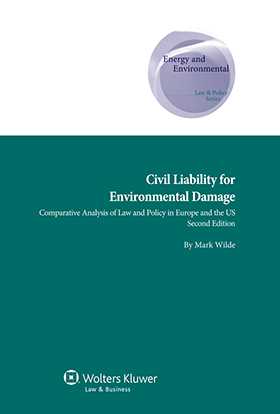
Each year, the number of serious accidents with devastating consequences for the environment continues to grow. Legal issues arising from such incidents highlight the impact of environmental damage not only on people and places, but on the interests of those held responsible. Moreover, it is now a truism to assert that pollution does not respect national frontiers – a perspective that greatly complicates matters of standing and jurisdiction. In this context the law of tort, whether it occurs through case law developments or legislative intervention, comes to the fore.
In the decade since the appearance of the first edition of this seminal work, the author has discerned indications that the debate on the role of tort in environmental law has moved on from the pros and cons of specific proposals to a more systemic approach. As litigants continue to test tort-based principles, some in hitherto uncharted waters such as climate change, the prospect of establishing tort as a component in a system of environmental protection has come to the fore.
In this thoroughly revised and updated edition, the author has sharpened his focus on such aspects of this emerging system as the following:
Through a detailed analysis of the fundamental nature of tort and the wider arguments concern-ing its proper function in modern society, this book offers compelling conclusions regarding how tort can play a part in developing a public trust doctrine in environmental law. No one with an interest in the development of environmental law can afford to ignore it.
Part I. Introductory Issues.
Chapter 1. The Law of Tort and the Environment: An Introduction to the Debate and Foundational Issues.
Part II. Traditional Tort-based Remedies and Environmental Protection: A Common Law Perspective.
Chapter 2. Conventional Tort-based Approaches to Environmental Harm.
Chapter 3. Establishing Liability for Environmental Damage: Main Issues.
Part III. The Role of Tort as a Means of Environmental Protection: Theoretical Perspectives and Legislative Initiatives.
Chapter 4. The Role of Tort in an Environmental Context.
Chapter 5. The European and International Dimension.
Part IV. Increasing the Role of Tort as a Means of Environmental Protection: A Comparative Analysis of Substantive Rules in Certain EU States and their Common Law Counterparts.
Chapter 6. Strict Liability.
Chapter 7. Reducing the Burden of Proof on Causation.
Chapter 8. Access to Justice I: Liberal Conferral of Standing.
Chapter 9. Access to Justice II: Class or Group Actions.
Chapter 10. Remedies for Environmental Damage.
Chapter 11. Financial Provision for Extended Civil Liability.
Part V. Conclusions.
Chapter 12. Conclusion: The Nature of Tort-based Liability in an Environmental Context.
 NEED HELP FINDING THE RIGHT SOLUTION?
Call sales at 1-800-638-8437
HAVE A QUESTION?


These cookies are necessary for the website to function. They are usually set in response to actions made by you which amount to a request for services, such as setting your privacy preferences, logging in or filling in forms. You can set your browser to block or alert you about these cookies, this may have an effect on the proper functioning of (parts of) the site.
These cookies enable the website to provide enhanced functionality, user experience and personalization, and may be set by us or by third party providers whose services we have added to our pages. If you do not allow these cookies, then some or all of these services may not function properly.
These cookies support analytic services that measure and improve the performance of our site. They help us know which pages are the most and least popular and see how visitors move around the site.
These cookies may collect insights to issue personalized content and advertising on our own and other websites, and may be set through our site by third party providers. If you do not allow these cookies, you may still see basic advertising on your browser that is generic and not based on your interests.
