Product Line | Kluwer Law International |
|---|---|
ISBN-13 | 9789403531076 |
Availability | Ships in 5-7 Business Days |
Last Updated | 2023-08-15 |
Bulletin of Comparative Law and Labour Relations
About this book:
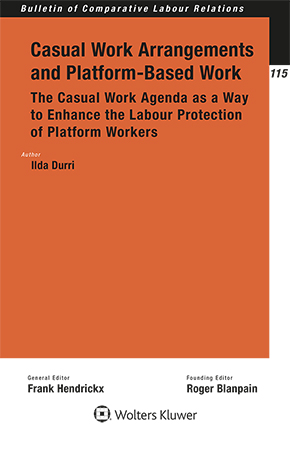
Casual Work Arrangements and Platform-Based Work is a trailblazing book offering in-depth research on specifically positioning platform work in the context of casual work arrangements. Platform work – in which work activities are channelled through web platforms or apps – has emerged as one of the major transitions in the world of work over the past decade. It presents several labour law issues related to casual work, often linked to insecure or precarious working conditions, such as unpredictable work schedules, an insecurity of work for the future, the lack of a stable income, and exclusion from even basic protections The author meticulously evaluates how strategies aimed at regulating casual work can be extended to enhance these insecure working conditions faced by platform workers.
What’s in this book:
In a nutshell, the issues and topics covered include the following:
This compendium is a thorough comparative legal analysis of casual work in four industrialized countries – the United Kingdom, the Netherlands, Belgium, and Italy – elucidating the divergent regulatory approaches to this work typology. Further, the book furnishes EU legislators’ efforts to establish a regulatory matrix on casual work, focusing on directives such as those on fixed-term work, working time, and transparent and predictable working conditions. The author sums it up with recommendations for redefining the EU legal initiative on platform work, in light of the national and EU legal instruments examined in this contribution. Issues, such as the insecure nature of work, unpaid standby time, and work insecurity, come to light.
How this will help you:
This vital book will aid policymakers and social partners to identify viable legal solutions to combat some of the labour protection challenges posed by platform work. At the same time, it will prove to be a reminder to EU policymakers that existing legal instruments on casual work constitute an available blueprint which could be beneficial in dealing with such regulatory difficulties. Finally, it will also provide legal scholars with an important insight into looking at platform work through the lens of casual work.
Notes on Author
Funder Acknowledgement
Preface
Acknowledgements
Introduction
PART I
A Comparative Legal Analysis of Casual Work in Four Industrialized Countries
CHAPTER 1
Defining Casual Work
CHAPTER 2
Zero-Hours Contracts in the United Kingdom
CHAPTER 3
Lavoro Intermittente in Italy
CHAPTER 4
On-call Work in the Netherlands
CHAPTER 5
Intermittent Work in Belgium
CHAPTER 6
A Comparative Legal Analysis of Casual Work in the United Kingdom, Italy, the Netherlands and Belgium
PART II
Welcome to the World of Platform Work
CHAPTER 7
Singling Out the Idiosyncratic Features of Platform Work
PART III
The EU Agenda on Casual Work and Platform Work: ‘Connecting the Dots’ Between Past, Present, and Future Legal Developments
CHAPTER 8
The Past: The Pathway to a European Regulatory Approach to Casual Work
CHAPTER 9
The Importance of The Working Time Directive for the Working Time Security of Casual and Platform Workers
CHAPTER 10
The Relevance of the Fixed-Term Work Directive for the Job Security of Casual and Platform Workers
CHAPTER 11
The Present: The Transparent and Predictable Working Conditions Directive as an Endeavour to Counter the Insecure Working Conditions Experienced by Casual and Platform Workers
CHAPTER 12
The Future: The Proposal for an EU Directive on Improving Working Conditions in Platform Work and the Employment Security of Platform Workers
Conclusions
Bibliography
Table of Cases
Table of Legislation
 NEED HELP FINDING THE RIGHT SOLUTION?
Call sales at 1-800-638-8437
HAVE A QUESTION?


These cookies are necessary for the website to function. They are usually set in response to actions made by you which amount to a request for services, such as setting your privacy preferences, logging in or filling in forms. You can set your browser to block or alert you about these cookies, this may have an effect on the proper functioning of (parts of) the site.
These cookies enable the website to provide enhanced functionality, user experience and personalization, and may be set by us or by third party providers whose services we have added to our pages. If you do not allow these cookies, then some or all of these services may not function properly.
These cookies support analytic services that measure and improve the performance of our site. They help us know which pages are the most and least popular and see how visitors move around the site.
These cookies may collect insights to issue personalized content and advertising on our own and other websites, and may be set through our site by third party providers. If you do not allow these cookies, you may still see basic advertising on your browser that is generic and not based on your interests.
