Product Line | Kluwer Law International |
|---|---|
ISBN-13 | 9789403538990 |
Availability | Ships in 5-7 Business Days |
Last Updated | 2026-06-16 |
Bulletin of Comparative Law and Labour Relations
About this book:
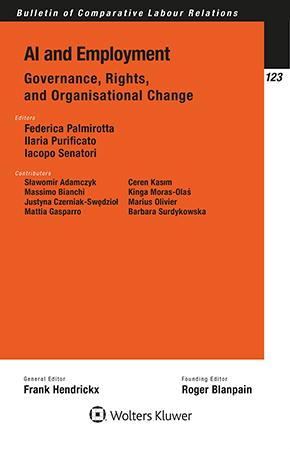
AI and Employment is an urgently needed book that gathers contributions from eight notable labour scholars addressing technological transformation as an ongoing disruptive process steadily reshaping the established categories, institutions, and protective guarantees of labour law, organization, and human resources management. The intensification and reconfiguration of employer power through artificial intelligence (AI) reinforce the need for new forms of employee protection.
What’s in this book:
Relying on an interdisciplinary analysis of AI’s impact on the employment relationship, the authors clarify such issues as the following:
The contributors emphasise the human-centred digital corporate responsibility model embodied in the European regulatory framework that encompasses the AI Act, the GDPR, the Corporate Sustainability Due Diligence Directive, and the Platform Work Directive. The insistence throughout is that no algorithm can replace the human capacities for judgment, responsibility, and solidarity on which labour law is ultimately built, and that AI cannot supersede human accountability, social dialogue, and sustainable leadership.
The book represents a selection of contributions originally presented at the annual international conference in commemoration of Marco Biagi held at the Marco Biagi Foundation in Modena on 19–20 March 2025, entitled ‘Employment in the Era of AI and Digital Platforms: Understanding and Regulating Transitions’.
How this will help you:
In its systematic assessment of risks to workers’ rights, equality, privacy, job security, and working conditions posed by AI – along with in-depth discussion of policy debates and collective responses to workplace AI – this book will help practitioners, policymakers, and businesses to identify risks of discrimination, opacity, and dehumanisation in algorithmic systems. In practical terms, it will assist in the development of design strategies for the ethical and fair use of AI at work, anticipate legal and organisational implications of AI and shape balanced responses.
Notes on Contributors
Editorial
PART I
Organisational and Management Perspectives
CHAPTER 1
Eclecticism and Unrealistic Perspectives in the Advancement of Management Theories Facing the Contingent Organizational Problems
Massimo Bianchi
CHAPTER 2
Management Versus Employees: AI Referees the Match
Mattia Gasparro
CHAPTER 3
HRM in the Era of AI: Are Humans Still Needed?
Kinga Moras-Olas & Justyna Czerniak-Swedziol
PART II
Legal and Industrial Relations Perspectives
CHAPTER 4
Employee Recruitment and Selection: Defining the Boundaries for the Use of AI
Marius Olivier
CHAPTER 5
Delegating the Undelegable? Agent-Based AI and the Limits of Artificial Collective Bargainers
Slawomir Adamczyk & Barbara Surdykowska
CHAPTER 6
Innovative Approaches: Using AI to Mitigate Work-Related Violence and Harassment
Ceren Kasim
 NEED HELP FINDING THE RIGHT SOLUTION?
Call sales at 1-800-638-8437
HAVE A QUESTION?


These cookies are necessary for the website to function. They are usually set in response to actions made by you which amount to a request for services, such as setting your privacy preferences, logging in or filling in forms. You can set your browser to block or alert you about these cookies, this may have an effect on the proper functioning of (parts of) the site.
These cookies enable the website to provide enhanced functionality, user experience and personalization, and may be set by us or by third party providers whose services we have added to our pages. If you do not allow these cookies, then some or all of these services may not function properly.
These cookies support analytic services that measure and improve the performance of our site. They help us know which pages are the most and least popular and see how visitors move around the site.
These cookies may collect insights to issue personalized content and advertising on our own and other websites, and may be set through our site by third party providers. If you do not allow these cookies, you may still see basic advertising on your browser that is generic and not based on your interests.
