Product Line | Kluwer Law International |
|---|---|
Product SKU | 10058828-0001 |
ISBN-13 | 9789041122537 |
Availability | Ships in 3-5 Business Days |
Last Updated | 2004-05-21 |
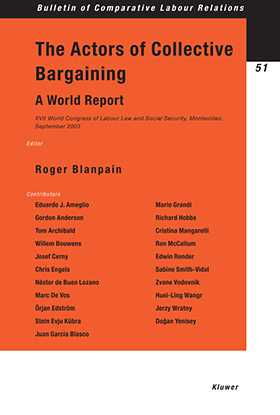
No one denies that the institution of collective bargaining between workers and employers has been a powerful tool for social dialogue. Without our history of effective collective bargaining there would be no mutual understanding, no industrial peace, no constructive cooperation between social partners. Yet there is a feeling today that this history has drawn to a close; that our post-industrial world demands something different, something our tradition of collective bargaining and collective agreements cannot give us.
What information and insight can we gather to verify or challenge this feeling? This was the first major question addressed by the distinguished delegates to the twenty-seventh World Congress of Labour and Social Security Law held at Montevideo, 2¿5 September 2003. The aim of the conference was to discover current problems regarding the existing structures and functions of collective bargaining in industrialized countries today¿problems readily identifiable in the context of economic globalization, falling union density, the increase in atypical and knowledge-based workers, and the ¿tertiarization¿ or declining economic importance of manufacturing-based industry.
This bulletin contains some of the most important papers devoted to this major theme of the conference. It presents twenty national reports, each written by a scholar well-versed in the law and practice of collective bargaining in the country covered. Two introductory reports deal with such general issues as the varying competences of representatives under different legal systems, labor union representation within the public sector, the development of collective bargaining in EC law, the levels and structures of collective bargaining practice, and the widening gap between the relevant legal norms and real situations.
The national reports were drafted on the basis of a questionnaire, which appears as an annex. This allows the reader to easily compare the solutions set forth for consideration in the various countries under review.
The Actors of Collective Bargaining will be of great value for all practitioners and academics in the field of industrial relations.
 NEED HELP FINDING THE RIGHT SOLUTION?
Call sales at 1-800-638-8437
 HAVE A QUESTION?


These cookies are necessary for the website to function. They are usually set in response to actions made by you which amount to a request for services, such as setting your privacy preferences, logging in or filling in forms. You can set your browser to block or alert you about these cookies, this may have an effect on the proper functioning of (parts of) the site.
These cookies enable the website to provide enhanced functionality, user experience and personalization, and may be set by us or by third party providers whose services we have added to our pages. If you do not allow these cookies, then some or all of these services may not function properly.
These cookies support analytic services that measure and improve the performance of our site. They help us know which pages are the most and least popular and see how visitors move around the site.
These cookies may collect insights to issue personalized content and advertising on our own and other websites, and may be set through our site by third party providers. If you do not allow these cookies, you may still see basic advertising on your browser that is generic and not based on your interests.
