Product Line | Kluwer Law International |
|---|---|
ISBN-13 | 9789403549194 |
Availability | Ships in 5-7 Business Days |
Last Updated | 2026-10-02 |
About this book:
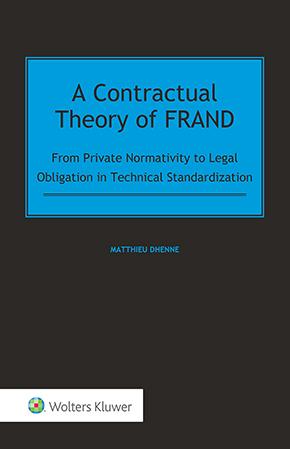
The FRAND Commitment is a book that develops a contractual theory of FRAND. It argues that technical standardization generates a form of private normativity by organizing conduct, dependence, and expectations of access. Those expectations do not, however, create an autonomous right to a license. Legal obligation arises from the individual FRAND undertaking made within the institutional framework of a standard-setting organization.
Technical standards are commonly presented as neutral instruments of interoperability. Their adoption, however, structures markets, directs investment, and creates forms of technological dependence whose consequences extend far beyond engineering. When patented technology becomes essential to a widely implemented standard, the resulting expectations of access raise a prior legal question: what makes an undertaking to license on fair, reasonable, and non-discriminatory terms legally binding?
What's in this book:
Focusing on the European Telecommunications Standards Institute (ETSI) and the French law governing its intellectual property policy, the book:
Drawing on EU law and French, U.K., German, U.S., Japanese, and selected Dutch materials, the book also explains why competition law retains an independent corrective function without supplying the private-law foundation of the FRAND undertaking.
Beyond the FRAND question itself, the study examines how law can give enforceable form to undertakings produced within privately organized technical infrastructures without surrendering legal judgment to technical or economic rationality. It shows how contract law can preserve both effective access to standardized technologies and the legitimate remuneration of patent holders.
How this will help you:
The book will be of particular interest to judges, lawyers, academics, policymakers, licensing professionals, and practitioners involved in standard-essential patent licensing and technical standardization.
Preface
Introduction
PART I
The Normative Foundations of FRAND
CHAPTER 1
Legal Qualification of Technical-Standard Normativity
CHAPTER 2
The Structuring of Technical-Standard Normativity
PART II
The Contractual Form of FRAND
CHAPTER 1
Legal Qualification of the FRAND Undertaking
CHAPTER 2
Performance of the FRAND Undertaking
Conclusion
Selected Bibliography
Table of Cases
Table of Treaties, Legislation and Other Instruments
 NEED HELP FINDING THE RIGHT SOLUTION?
Call sales at 1-800-638-8437
HAVE A QUESTION?


These cookies are necessary for the website to function. They are usually set in response to actions made by you which amount to a request for services, such as setting your privacy preferences, logging in or filling in forms. You can set your browser to block or alert you about these cookies, this may have an effect on the proper functioning of (parts of) the site.
These cookies enable the website to provide enhanced functionality, user experience and personalization, and may be set by us or by third party providers whose services we have added to our pages. If you do not allow these cookies, then some or all of these services may not function properly.
These cookies support analytic services that measure and improve the performance of our site. They help us know which pages are the most and least popular and see how visitors move around the site.
These cookies may collect insights to issue personalized content and advertising on our own and other websites, and may be set through our site by third party providers. If you do not allow these cookies, you may still see basic advertising on your browser that is generic and not based on your interests.
