Product Line | Kluwer Law International |
|---|---|
ISBN-13 | 9789403529394 |
Availability | Ships in 5-7 Business Days |
Last Updated | 2025-08-14 |
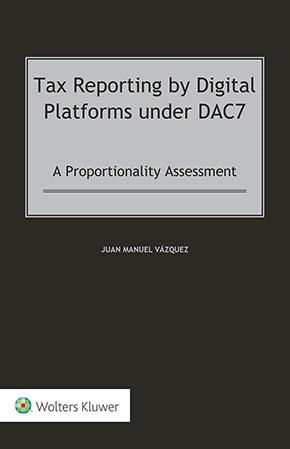
Tax Reporting by Digital Platforms under DAC7 is a book furnishing a comprehensive and in-depth assessment of the proportionality of DAC7 rules for digital platforms. It examines whether these rules are aligned with the general European Union (EU) law principle of proportionality from both a policy and legal perspective and when this is not the case, it identifies potential improvements that could be made to ensure such alignment.
In early 2021, the EU introduced a standardized tax reporting requirement for digital platforms through a Council Directive known as DAC7. The rules introduced by this Directive require third-party operators of digital platforms to systematically collect, verify, store, and report specific personal and transactional data about platform sellers to the tax authorities of the Member States. This data is then automatically exchanged between tax authorities. While DAC7 rules for digital platforms pursue a worthy goal (e.g., combating tax evasion) which, at first glance, would justify a public intrusion into the private sphere of both platform sellers and third-party platform operators, a key question that arises is whether such intrusion does not exceed what is necessary for the public interest. This essentially concerns a matter of ‘means’ and ‘ends’ or, in other words, of proportionality.
What’s in this book:
This book covers the following issues and topics:
How this will help you:
In its comprehensive, systematic, and in-depth proportionality assessment of DAC7 rules for digital platforms, this book will prove to be of help and guidance to practitioners, administrators, academics, the judiciary, policymakers, and citizens navigate these rules, their practical application, and their policy and legal implications.
List of Acronyms and Abbreviations
Preface
Acknowledgements
Introduction
PART I
Digital Platforms, Their Regulation and the Tax Reporting Obligations Imposed under DAC7
CHAPTER 1
Digital Platforms and the Sharing and Gig Economy
CHAPTER 2
Impacts, Regulatory Landscape and Tax Compliance Aspects of the Platform Economy
CHAPTER 3
Tax Reporting by Digital Platforms under DAC7 and the OECD Model Rules
PART II
Proportionality and Its Different Dimensions
CHAPTER 4
The Principle of Proportionality and Its Legal Dimension
CHAPTER 5
The Principle of Proportionality and Its Policy Dimension
PART III
DAC7’s Proportionality from a Policy Perspective
CHAPTER 6
Assessing DAC7’s Policymaking Process from a Proportionality Perspective
CHAPTER 7
Assessing the Proportionality of DAC7 as a Policy Option
PART IV
DAC7’s Proportionality from a Legal Perspective
CHAPTER 8
Assessing DAC7’s Interference with Fundamental Rights
CHAPTER 9
Assessing DAC7’s Interference with Treaty Freedoms and Legal Certainty
CHAPTER 10
Applying the Legal Proportionality Test to DAC7
PART V
Recommendations
CHAPTER 11
Short and Medium-Term Recommendations to Improve DAC7’s Proportionality
CHAPTER 12
Long-Term Recommendations to Improve DAC7’s Proportionality: Moving Towards an Integrated Data-Sharing Model
Conclusion
Summary
Bibliography
Table of Cases
Table of Legislation
 NEED HELP FINDING THE RIGHT SOLUTION?
Call sales at 1-800-638-8437
HAVE A QUESTION?


These cookies are necessary for the website to function. They are usually set in response to actions made by you which amount to a request for services, such as setting your privacy preferences, logging in or filling in forms. You can set your browser to block or alert you about these cookies, this may have an effect on the proper functioning of (parts of) the site.
These cookies enable the website to provide enhanced functionality, user experience and personalization, and may be set by us or by third party providers whose services we have added to our pages. If you do not allow these cookies, then some or all of these services may not function properly.
These cookies support analytic services that measure and improve the performance of our site. They help us know which pages are the most and least popular and see how visitors move around the site.
These cookies may collect insights to issue personalized content and advertising on our own and other websites, and may be set through our site by third party providers. If you do not allow these cookies, you may still see basic advertising on your browser that is generic and not based on your interests.
