Product Line | Kluwer Law International |
|---|---|
ISBN-13 | 9789403527291 |
Availability | Ships in 5-7 Business Days |
Last Updated | 2025-12-09 |
About this book:
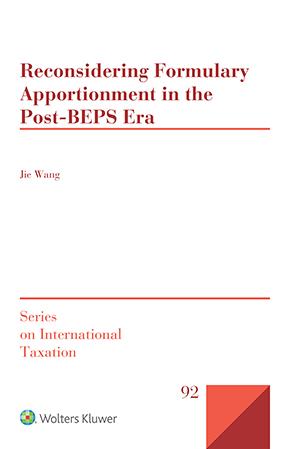
Reconsidering Formulary Apportionment in the Post-BEPS Era is a ground-breaking book exploring in great depth how formulary apportionment (FA) – by which multinational enterprises (MNEs) allocate profits across countries based on real activity in each jurisdiction, thus removing the incentive to shift reported income to low-tax locations – can become a fundamental reform option in the evolving context of international taxation. The OECD’s Base Erosion and Profit Shifting (BEPS) Project and its maturing ‘two-pillar solution’ have their origin in a consensus that the existing international tax system requires significant reform, particularly in addressing the taxation of MNEs and the digitalization of the global economy.
What’s in this book:
In light of the fact that FA represents a transition from a bilateral to a multilateral mechanism, it becomes crucial to study how each ‘market country’ assesses its feasibility. This research selects China, thus concentrating on the dynamics of one of the world’s largest economies, and demonstrating the broad implications of China’s ongoing strategic FA experiment for the global tax system.
The author considers and analyses such aspects of the subject as the following:
Included is a comparative study of the current FA systems in the United States, Canada, the European Union’s Common Consolidated Corporate Tax Base (CCCTB) Proposal, and the newly introduced Pillar One Amount A. By deconstructing these systems into constituent elements, the author offers a component-by-component analysis and extracts lessons for the future architecture of international FA, with respect to highlighting its function and what practical lessons can be drawn.
How this will help you:
With the digital transformation exacerbating existing tax system flaws to an intolerable level for most stakeholders, and as dissatisfaction with the current allocation framework has grown among both developing and developed nations, the re-emergence of formulary apportionment is becoming an increasingly concrete reality in the modern global economy. Recognizing the continuing efforts to improve the international tax system, this book explores the foundational values and principles that need to be considered when developing an analytical framework for formulary apportionment, with practical insights for reform on a global level. It will be highly appreciated by tax professionals, policymakers, and researchers worldwide.
About the Author
List of Abbreviations
List of Equations
List of Figures
List of Tables
CHAPTER 1
Introduction
PART I
Formulary Apportionment at the Historical Turning Point
CHAPTER 2
Historical Analysis: Formulary Apportionment as a Key Indicator
PART II
Some Experience from the Real World
CHAPTER 3
A Comparative Analysis of the ‘Existing’ Formulary Apportionment ‘Regimes’: US, Canada, (the Withdrawn)
EU CCCTB Proposal, and the Pillar One Amount A
PART III
Constructing the Analytical Framework for Formulary Apportionment
CHAPTER 4
The Principle of Equity
CHAPTER 5
The Principle of Legitimacy
CHAPTER 6
Efficiency Considerations: The Questionable Usefulness of Neutrality
PART IV
Testing and Experimenting with Formulary Apportionment in China
CHAPTER 7
From Source-Oriented to Residence-Oriented: China’s International Tax Regime Reshaped by BRI
CHAPTER 8
Strategical Viability of China Exploring Formulary Apportionment
CHAPTER 9
China Biting the ‘Wolf Peach’: The Possible Design and the Roadmap
PART V
The Epilogue
CHAPTER 10
Conclusion
Bibliography
 NEED HELP FINDING THE RIGHT SOLUTION?
Call sales at 1-800-638-8437
HAVE A QUESTION?


These cookies are necessary for the website to function. They are usually set in response to actions made by you which amount to a request for services, such as setting your privacy preferences, logging in or filling in forms. You can set your browser to block or alert you about these cookies, this may have an effect on the proper functioning of (parts of) the site.
These cookies enable the website to provide enhanced functionality, user experience and personalization, and may be set by us or by third party providers whose services we have added to our pages. If you do not allow these cookies, then some or all of these services may not function properly.
These cookies support analytic services that measure and improve the performance of our site. They help us know which pages are the most and least popular and see how visitors move around the site.
These cookies may collect insights to issue personalized content and advertising on our own and other websites, and may be set through our site by third party providers. If you do not allow these cookies, you may still see basic advertising on your browser that is generic and not based on your interests.
