Product Line | Kluwer Law International |
|---|---|
Product SKU | 10059296-0001 |
ISBN-13 | 9789041167316 |
Availability | Ships in 3-5 Business Days |
Last Updated | 2016-05-25 |
Information Law Series Volume 36
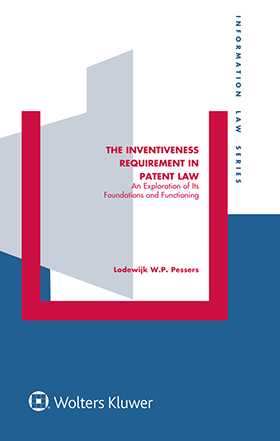
The Inventiveness Requirement in Patent Law provides a broad and historical perspective on the inventiveness concept in patent law. This groundbreaking work lays a very thorough conceptual basis for further and more in-depth discussions on current standards of inventiveness. Although the pivotal role of the inventiveness requirement in patent law is broadly accepted, it has long remained an ill-defined concept. The question that is often raised in current debates is whether the requirement is capable of functioning as an adequate ‘gate-keeper’.
Using a methodology guided by geography and chronology, the author weaves together developments in numerous countries – focusing primarily on the United States, the United Kingdom, Germany, and the Netherlands – into a full-scale analysis of the inventiveness concept.
What’s in this book:
Among the questions raised and examined are the following:
The author tries to answer the question of how the requirement of inventiveness (in patent law) has evolved over time. In doing so, he focuses on three aspects in particular: (i) the historical phases that can be discerned in the requirement’s evolution; (2) the socio-economic and political forces that have determined or influenced its course; and (3) the similarities and dissimilarities between the jurisdictions under examination (i.e., the United States, the United Kingdom, Germany and the Netherlands).
For reasons of structure and overview, the book is divided into two parts. The first part describes the evolution of inventiveness requirements in its first three phases: medieval, mercantilist and pre-modern. The second part is dedicated to the modern phase and pays particular attention to two different ‘schools of thought’ that developed in the 19th century and which continue to be relevant for the doctrine’s direction, even today.
How will this help you:
This book provides crucially important fundamental commentary for lawyers, jurists, and scholars coming to grips with a hugely complex legal phenomenon: the dramatic growth, worldwide, in recent years of patents as instruments for the protection of industrial property. This book discusses the legislative and jurisprudential developments, as well as the extra-legal aspects – social, economic, political, and administrative – of the inventiveness in patent law. This excellent analysis is particularly welcome in these times of intensifying scrutiny of patent law and is sure to rapidly become a cornerstone resource for intellectual property lawyers, patent officers, in-house counsel in multinational manufacturing companies, and other interested practitioners.
Acknowledgements
List of Abbreviations
Introduction
Part I The Early History of the Inventiveness Requirement
Chapter 1 The Early History of the Inventiveness Requirement: Preliminary Remarks
Chapter 2 Antiquity and Medieval Europe
Chapter 3 The Republic of Venice
Chapter 4 The Venetian Patent Practice Spreading through Europe
Chapter 5 England
Chapter 6 United States
Part II The Inventiveness Requirement in Its Modern Phase
Chapter 7 The Inventiveness Requirement in Its Modern Phase: Preliminary Remarks
Chapter 8 Inventiveness in the Age of Modernization
Chapter 9 The Further Rise of the Inventiveness Standard
Chapter 10 The Invention, the Inventor and the Workman
Chapter 11 Systematization
Summary and Conclusion
Bibliography
Table of Cases
Index
 NEED HELP FINDING THE RIGHT SOLUTION?
Call sales at 1-800-638-8437
HAVE A QUESTION?


These cookies are necessary for the website to function. They are usually set in response to actions made by you which amount to a request for services, such as setting your privacy preferences, logging in or filling in forms. You can set your browser to block or alert you about these cookies, this may have an effect on the proper functioning of (parts of) the site.
These cookies enable the website to provide enhanced functionality, user experience and personalization, and may be set by us or by third party providers whose services we have added to our pages. If you do not allow these cookies, then some or all of these services may not function properly.
These cookies support analytic services that measure and improve the performance of our site. They help us know which pages are the most and least popular and see how visitors move around the site.
These cookies may collect insights to issue personalized content and advertising on our own and other websites, and may be set through our site by third party providers. If you do not allow these cookies, you may still see basic advertising on your browser that is generic and not based on your interests.
