Product Line | Kluwer Law International |
|---|---|
ISBN-13 | 9789403508283 |
Availability | Ships in 5-7 Business Days |
Last Updated | 2024-11-22 |
About this book:
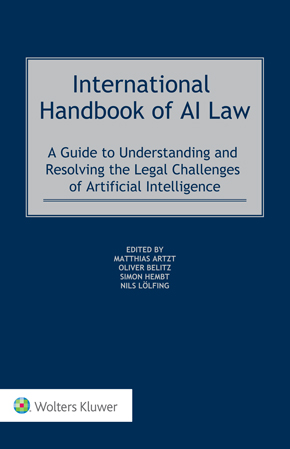
International Handbook of AI Law, an indispensable handbook, written in clear language by international experts from all over the world, elucidates the complex relationship between AI and the law, covering both existing laws and emerging AI-specific legal regulations. Recently, the field of Artificial Intelligence (AI) has seen remarkable advances, revolutionizing how we live, work, and interact with technology. As AI systems grow increasingly sophisticated and autonomous, they raise new and challenging legal questions, particularly regarding AI-specific risks associated with automated systems.
What’s in this book:
This book commences with a comprehensive and insightful technical analysis of how AI works and progresses with chapters covering a wide array of legal fields relevant to AI technology focusing on the legal framework in the EU.
The topics included are:
The book concludes with country reports on the legal and regulatory environment in the United Kingdom, the United States, China, and Japan, contrasting them with the EU legal framework.
How this will help you:
Every chapter provides pragmatic advice on the implementation of legal principles, making the handbook a valuable resource for real-world applications. This essential guide will prove to be immensely valuable to practitioners, policymakers, academics, and others seeking a deep understanding of the complex legal challenges posed by AI use. The handbook aids in responsible and trustworthy AI development and use by guiding decision-making, reducing risks, and protecting the rights and well-being of individuals and society.
Editors
Contributors
List of Abbreviations
Preface
CHAPTER 1
Understanding AI
Jake van der Laan
CHAPTER 2
The EU Artificial Intelligence Act
Oliver Belitz, Nils Lölfing & Simon Hembt
CHAPTER 3
AI-Specific Liability and Product Safety
Nils Lölfing
CHAPTER 4
Data Protection Law
Nils Lölfing, Claudia Bischoff-Briel & Anke Dieckhoff
CHAPTER 5
Data Law
Nils Lölfing, Claudia Bischoff-Briel, Anke Dieckhoff & Lea Noemi Mackert
CHAPTER 6
Intellectual Property Law
Simon Hembt & Jonas Smeets
CHAPTER 7
Contracting
Lea Noemi Mackert & Nils Lölfing
CHAPTER 8
Antitrust
Stephan Waldheim
CHAPTER 9
Criminal Law
Eren Basar
CHAPTER 10
Cybersecurity
Claudia Bischoff-Briel & Anke Dieckhoff
CHAPTER 11
Employment Law
Carina Wirtz
CHAPTER 12
Legal Tech
Oliver Belitz & Johannes Jung
CHAPTER 13
Comparative Law Perspective: United Kingdom
Toby Bond, Louise O’Hara, William Wortley, Alex Jameson & Kate Deniston
CHAPTER 14
Comparative Law Perspective: United States of America
Kaylee Cox Bankston, Liza Craig & Bethany Withers
CHAPTER 15
Comparative Law Perspective: Japan
Noboru Kitayama & Kohei Wachi
CHAPTER 16
Comparative Law Perspective: China
James Gong, Dorie Wong & Harry Qu
Bibliography
Index
The "International Handbook of AI Law" is a comprehensive and valuable resource for legal professionals, policymakers, and technologists addressing the legal challenges posed by AI. Its comprehensive coverage, expert contributions, and practical recommendations make it an essential guide for navigating the complex legal landscape of AI. A must have for both novices to as well as experts in the field that is subject to rapid change and evolvement.
It provides actionable items and practical recommendations for implementing AI-driven solutions while ensuring compliance with legal standards. It includes historical context, definitions, types of AI, machine learning techniques, algorithms, processes, and regulatory frameworks.
Expert Contributions: The book features contributions from numerous legal experts, providing diverse perspectives and in-depth analyses. This enhances the credibility and richness of the content.
Practical Recommendations: The inclusion of actionable items and practical recommendations is highly valuable for practitioners. These guidelines help companies and legal professionals implement AI-driven solutions while ensuring compliance with legal standards.
The authors effectively integrate technical aspects of AI with legal analysis. This interdisciplinary approach is crucial for understanding the complexities of AI and its legal implications.
Conclusion: The "International Handbook of AI Law" is a valuable resource for legal professionals, policymakers, and technologists. Its comprehensive coverage, expert contributions, and practical recommendations make it an essential guide for navigating the complex legal landscape of AI. — Ingo Hatzmann, General Counsel at E&Y Germany, April 2025.
The EU AI Act is the first comprehensive regulation to address the risks of artificial intelligence. However, the issues associated with the use of AI go beyond the EU AI Act and are also not limited to the European Union. The “International Handbook of AI Law” covers a large part of the issues associated with the use of AI on almost 800 pages - from liability to data protection and IP law. But antitrust law and criminal law are also covered, to mention the sometimes neglected topics. The subtitle “A Guide to understanding and Resolving the Legal Challenges of Artificial Intelligence” chosen by the editors fits perfectly. —Thomas Sassenberg - Kyndryl Deutschland GmbH
 NEED HELP FINDING THE RIGHT SOLUTION?
Call sales at 1-800-638-8437
HAVE A QUESTION?


These cookies are necessary for the website to function. They are usually set in response to actions made by you which amount to a request for services, such as setting your privacy preferences, logging in or filling in forms. You can set your browser to block or alert you about these cookies, this may have an effect on the proper functioning of (parts of) the site.
These cookies enable the website to provide enhanced functionality, user experience and personalization, and may be set by us or by third party providers whose services we have added to our pages. If you do not allow these cookies, then some or all of these services may not function properly.
These cookies support analytic services that measure and improve the performance of our site. They help us know which pages are the most and least popular and see how visitors move around the site.
These cookies may collect insights to issue personalized content and advertising on our own and other websites, and may be set through our site by third party providers. If you do not allow these cookies, you may still see basic advertising on your browser that is generic and not based on your interests.
