Product Line | Kluwer Law International |
|---|---|
ISBN-13 | 9789403510590 |
Availability | Ships in 5-7 Business Days |
Last Updated | 2025-07-16 |
About this book:
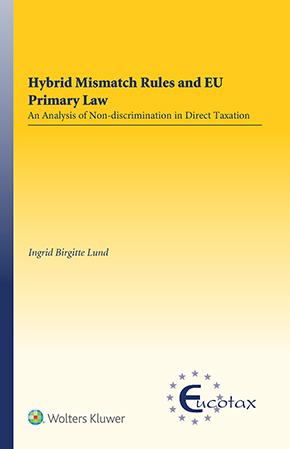
Hybrid Mismatch Rules and EU Primary Law is a book exploring whether the transposed national hybrid mismatch rules, as enacted based on Articles 9, 9a, and 9b of the EU Anti-Tax Avoidance Directive (ATAD), infringe on taxpayers’ right to free movement under the fundamental freedoms and clarifies the extent of the protection these freedoms afford in direct tax cases. Hybrid mismatch rules obligate Member States to alter the tax treatment for cross-border transactions to prevent non-taxation or double non-taxation which may occur when a transaction is not only deductible for the payer but also deductible or not taxed as income for the payee.
What’s in this book:
The author’s in-depth analysis extends to the following considerations:
How this will help you:
Acknowledging the conflict within international tax law between competition and cooperation – including the extent to which a taxpayer covered by the hybrid mismatch rules, by invoking the fundamental freedoms, can claim the benefits that hybrid mismatch rules deprive them of – the answers and clarifications in this deeply informed book contribute to foreseeability and legal certainty for both corporations and governments. With it as a guide, practitioners and policymakers will effectively apply hybrid mismatch rules, gain a deeper understanding of how these regulations influence taxpayers and their rights to free movement, and recognize how fundamental freedoms can be utilized for taxpayer protection.
List of Abbreviations
Foreword
Preface and Acknowledgements
CHAPTER 1
Introduction
CHAPTER 2
Adoption of Hybrid Mismatch Provisions in EU Tax Law
CHAPTER 3
Hybrid Mismatch Provisions Tax Consequences for Taxpayers
CHAPTER 4
Primary EU Law: Formal and Material Competence and Limitations
CHAPTER 5
Fundamental Freedoms as a Constitutional Framework for Direct Tax Directives
CHAPTER 6
The Applicability and Choice of Freedom in Hybrid Mismatch Situations
CHAPTER 7
Do the Hybrid Mismatch Rules Constitute a Restriction?
CHAPTER 8
Are Hybrid Mismatch Rules Justified to Prevent Tax Avoidance?
CHAPTER 9
Are the Hybrid Mismatch Rules Proportional?
CHAPTER 10
Conclusions and Issues for Debate
Bibliography
Table of Cases
Table of Official Documentation
Index
 NEED HELP FINDING THE RIGHT SOLUTION?
Call sales at 1-800-638-8437
HAVE A QUESTION?


These cookies are necessary for the website to function. They are usually set in response to actions made by you which amount to a request for services, such as setting your privacy preferences, logging in or filling in forms. You can set your browser to block or alert you about these cookies, this may have an effect on the proper functioning of (parts of) the site.
These cookies enable the website to provide enhanced functionality, user experience and personalization, and may be set by us or by third party providers whose services we have added to our pages. If you do not allow these cookies, then some or all of these services may not function properly.
These cookies support analytic services that measure and improve the performance of our site. They help us know which pages are the most and least popular and see how visitors move around the site.
These cookies may collect insights to issue personalized content and advertising on our own and other websites, and may be set through our site by third party providers. If you do not allow these cookies, you may still see basic advertising on your browser that is generic and not based on your interests.
