
Mark S. Brodin
Professor of Law & Michael and Helen Lee Distinguished Scholar
Mark S. Brodin is Professor of Law, Michael and Helen Lee Distinguished Scholar, and former Associate Dean for Academic Affairs at Boston College Law
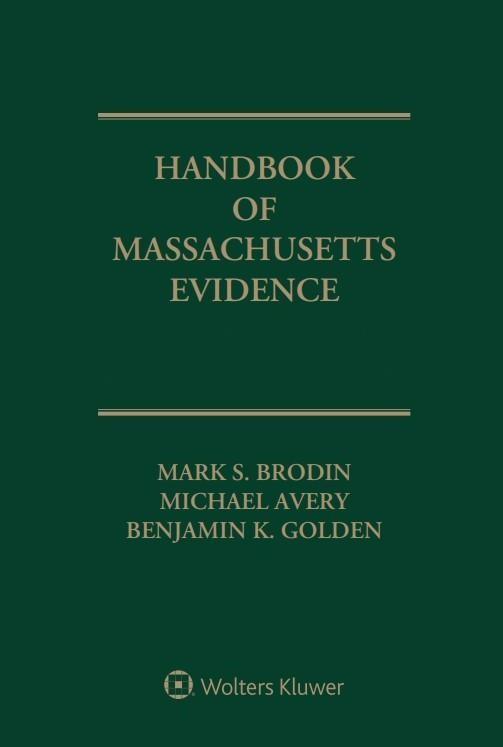
The Handbook of Massachusetts Evidence is a comprehensive and practical guide to the law of evidence in Massachusetts. Providing clear explanations of the settled law and expert advice on more complicated evidentiary problems, this one-volume compendium provides in-depth coverage of everything attorneys need for analyzing and weighing evidence, planning litigation strategy, and justifying objections. It is an invaluable aid in determining the use and admissibility of evidence in Massachusetts courts.
Previous Edition: Handbook of Massachusetts Evidence, 2026 Edition, ISBN 9781543882636
Note: Online subscriptions are for three-month periods.
Preface xxv
Special Notice xxvii
CHAPTER 1
GENERAL PROVISIONS 1
A. Introduction 2
§ 1.1 Sources 2
§ 1.2 Applicability 3
B. Excluding Evidence 7
§ 1.3 Objection/Motion to Strike/Offer of Proof 7
§ 1.3.1 Necessity for Objection or Motion to Strike 7
§ 1.3.2 Timeliness 13
§ 1.3.3 Form of the Objection/Specificity 14
§ 1.3.4 Offer of Proof 16
§ 1.4 The Ruling 17
§ 1.4.1 Preliminary Questions of Fact 17
§ 1.4.2 Correction of Erroneous Ruling 20
C. General Considerations Concerning Admissibility 21
§ 1.5 Limited Admissibility/Limiting Instructions 21
§ 1.6 Conditional Admissibility 22
§ 1.7 Rule of Verbal Completeness 22
§ 1.8 Curative Admissibility/Opening the Door 25
D. Juror Selection 26
§ 1.9 Individual Juror Voir Dire for Bias or Prejudice 26
§ 1.10 Discriminatory Use of Peremptory Challenges—Batson 39
CHAPTER 2
JUDICIAL ADMISSIONS, JUDICIAL NOTICE, AND
BINDING TESTIMONY 45
§ 2.1 Introduction 46
A. Judicial Admissions 46
§ 2.2 Effect of Judicial Admissions 46
§ 2.3 Admissions Under the Massachusetts Rules of Civil Procedure 46
§ 2.3.1 Rule 36 46
§ 2.3.2 Rule 16 47
§ 2.3.3 Rules 8(b) and 9(a) 48
§ 2.4 Statutory Admissions 48
§ 2.4.1 Demand for Admission of Fact or Execution of
Paper
§ 2.4.2 Pleadings as Admissions 49
§ 2.5 Common-Law Admissions 51
§ 2.5.1 Judicial Estoppel 53
B. Judicial Notice 56
§ 2.6 Proposed Massachusetts Rule of Evidence and Federal Rule of
Evidence 201 56
§ 2.7 Meaning and Purpose of Judicial Notice 57
§ 2.8 Matters Subject to Judicial Notice 57
§ 2.8.1 Law 57
a. Domestic Law 57
b. Law of Other Jurisdictions 60
§ 2.8.2 Fact 62
§ 2.9 Conclusiveness of Judicial Notice 65
§ 2.10 Miscellaneous Statutes 65
C. Binding Testimony 66
§ 2.11 Definition and Application of Doctrine 66
CHAPTER 3
BURDEN OF PROOF, PRESUMPTIONS, AND
INFERENCES 69
§ 3.1 Burden of Proof Defined 70
§ 3.2 Burden of Production/Civil and Criminal Cases 71
§ 3.2.1 Amount of Evidence Required/Motions to
Challenge 71
§ 3.2.2 Allocation of Burden of Production 73
§ 3.2.3 Discrimination Cases 74
§ 3.3 Burden of Persuasion in Civil Cases 76
§ 3.3.1 Allocation of Burden of Persuasion in Civil Cases 76
a. General Principles 76
b. Actions Alleging Statutory Liability 77
c. Affirmative Defenses 77
§ 3.3.2 Degree of Persuasion in Civil Cases 78
a. Preponderance of the Evidence 78
b. Clear and Convincing Evidence 80
c. Beyond a Reasonable Doubt 83
d. Standards of Proof Under Administrative
Procedure Act 84
§ 3.4 Burden of Persuasion in Criminal Cases 84
§ 3.4.1 Allocation of Burden of Persuasion in Criminal
Cases 84
§ 3.4.2 Degree of Persuasion in Criminal Cases 89
a. Proof Beyond a Reasonable Doubt 89
b. “Reasonable Doubt” Defined/Jury
Instructions 89
§ 3.5 Presumptions/Prima Facie Evidence/Inferences 93
§ 3.5.1 Conclusive or Irrebuttable Presumptions 94
§ 3.5.2 Presumptions as Shorthand References 96
§ 3.5.3 Prima Facie Evidence & Traditional Presumptions 97
§ 3.5.4 Inferences 106
§ 3.5.5 Conflicting Presumptions 107
§ 3.5.6 Presumptions in Criminal Cases 108
§ 3.6 Adverse Inferences 112
§ 3.6.1 In General/Bowden Defense 112
§ 3.6.2 Failure to Call Witnesses 115
CHAPTER 4
RELEVANCE AND CIRCUMSTANTIAL PROOF 123
§ 4.1 Relevance 124
§ 4.1.1 Defined 124
§ 4.1.2 Relevancy and Admissibility 125
§ 4.2 Direct and Circumstantial Evidence 132
§ 4.2.1 Consciousness of Guilt/Innocence; Consciousness
of Liability Evidence 135
§ 4.2.2 Third-Party Culprit Evidence 142
§ 4.2.3 Statistical and Probabilistic Evidence 144
§ 4.2.4 Negative Evidence 146
§ 4.2.5 Demonstrative Evidence 148
§ 4.2.6 Views 149
§ 4.3 Discretion to Exclude Relevant Evidence 150
§ 4.3.1 Discussion 150
§ 4.3.2 Photographs of the Victim and Crime Scene 157
§ 4.4 Character Evidence 160
§ 4.4.1 General Inadmissibility of Character Evidence to
Prove Conduct 160
§ 4.4.2 Character of the Criminal Defendant 163
§ 4.4.3 Character of the Victim in a Criminal Case 168
a. Self-Defense 168
b. “Rape Shield” Statute 173
§ 4.4.4 Form of Character Evidence/Reputation 181
§ 4.4.5 Character Evidence in Civil Cases 183
§ 4.4.6 Specific Act Evidence for Non-Propensity Purposes 184
§ 4.4.7 Specific Act Evidence Offered by Defendant 198
§ 4.4.8 Habit and Custom 200
§ 4.4.9 Similar Circumstances Offered for Various
Purposes 202
a. Similar Occurrences 202
b. Similar Transactions/Sale Price of Similar
Land 205
c. Similar and Altered Objects 206
d. Experimental Evidence 207
e. Demonstrations 210
f. Computer-Generated Simulations 210
§ 4.5 Subsequent Repairs 211
§ 4.6 Compromise and Offers to Compromise/Expressions of
Sympathy or Apology/Payment of Medical Expenses/Offers to
Plead Guilty 214
§ 4.7 Liability Insurance 219
CHAPTER 5
PRIVILEGES AND DISQUALIFICATIONS 223
§ 5.1 Introduction 224
§ 5.2 Husband-Wife 227
§ 5.2.1 Disqualification of Spouses to Disclose Private
Conversations 227
§ 5.2.2 Privilege of Spouse Not to Testify Against Other
Spouse in Criminal Case 231
§ 5.2.3 Comparison Between the Statutory Disqualification
and Privilege 234
§ 5.2.4 Abandonment of Lord Mansfield’s Rule
Disqualifying Spouses from Testifying as to
Illegitimacy of Child 234
§ 5.3 Parent-Child 235
§ 5.4 Attorney-Client 236
§ 5.4.1 Introduction 236
§ 5.4.2 “Client” or “Prospective Client” Defined 239
§ 5.4.3 “Member of the Bar” Defined 240
§ 5.4.4 “Communications”/“Facts” Distinguished 241
§ 5.4.5 “In Confidence” Defined/Disclosure to Third
Persons 242
§ 5.4.6 “Privileged at the Option of the Client” 244
§ 5.4.7 Exceptions 245
§ 5.4.8 Waiver 247
§ 5.4.9 Comment upon Claim of Privilege 249
§ 5.4.10 Work Product 250
§ 5.4.11 Attorney as Witness 253
§ 5.5 Physician-Patient; Psychotherapist-Patient; Social Worker-
Client; Counselor-Victim; Court-Ordered Psychiatric
Examination 254
§ 5.5.1 Physician-Patient Confidentiality 254
§ 5.5.2 Psychotherapist-Patient Privilege 255
§ 5.5.3 Social Worker-Client Confidentiality and Privilege 263
§ 5.5.4 Privilege Overridden by Constitutional Rights 267
§ 5.5.5 Confidential Communications to Sexual Assault
and Domestic Violence Counselors 272
§ 5.5.6 Inadmissibility of Statements Made During Court-
Ordered Psychiatric Examination 273
§ 5.6 Priest-Penitent 275
§ 5.7 Deliberations of Jurors and Judicial Officers/Extraneous
Influences upon Jury Deliberations/Post-Verdict Interviews 277
§ 5.8 Informers/Surveillance Location 283
§ 5.9 Journalists 288
§ 5.10 Public Records and Reports/“Governmental Privilege” 290
§ 5.10.1 Judicial Deliberation Privilege 299
§ 5.10.2 Medical Peer Review Committee Records 300
§ 5.11 Tax Returns/Accountant Privilege 301
§ 5.12 Political Vote 302
§ 5.13 Trade Secrets 303
§ 5.14 Privilege Against Self-Incrimination 303
§ 5.14.1 Introduction 303
§ 5.14.2 Availability of the Privilege 305
a. Governmental Compulsion 305
b. Testimonial Evidence/Act of Production
Doctrine/Refusal Evidence 307
c. Reasonable Possibility of Incriminating the
Witness in Criminal Proceedings 312
§ 5.14.3 Assertion in Civil or Criminal Proceeding 317
§ 5.14.4 Required Records Exception 319
§ 5.14.5 Who May Claim the Privilege 319
§ 5.14.6 Claim of the Privilege 322
§ 5.14.7 Overcoming the Privilege 325
a. Waiver 325
b. Removal by Grant of Immunity/
Corroboration Requirement 330
§ 5.14.8 Comment upon and Adverse Inference from Claim
of Privilege 335
§ 5.15 Limitation on Privileges and Disqualifications in Proceedings
Arising out of Abuse of Disabled Persons 340
CHAPTER 6
WITNESSES 341
A. Basics 342
§ 6.1 Attendance/Compulsory Process/Subpoenas/Discovery 342
§ 6.2 Sequestration 347
§ 6.3 Competency/Oath 349
§ 6.4 Special Arrangements for the Child Witness 354
§ 6.5 Personal Knowledge 355
B. Presenting Evidence 356
§ 6.6 Order of Presentations and Examination of Witnesses/Role of
the Trial Judge 356
§ 6.6.1 Right to Public Trial 362
§ 6.7 Scope and Extent of Cross-Examination 365
§ 6.8 Cross-Examination in Criminal Cases—Right of Confrontation 368
§ 6.9 Redirect and Re-Cross-Examination 372
§ 6.10 Leading Questions 373
§ 6.11 Questions Improper as to Form 375
C. Impeachment 377
§ 6.12 Introduction 377
§ 6.13 By Contradiction 380
§ 6.13.1 Contradiction by W2 381
§ 6.13.2 Contradiction by Prior Inconsistent Statement 382
a. General Considerations 382
b. Nature of the Inconsistency 384
c. Special Provisions for Impeachment in
Criminal Cases 388
d. Special Provisions for Impeachment in Tort
Actions and Worker’s Compensation
Proceedings 389
e. Impeachment by Silence or Failure to Come
Forward 390
f. Mechanics of Impeachment/Extrinsic Proof 393
g. Use of Statement Generally Limited to
Impeachment/Exception for Substantive
Use 396
§ 6.13.3 Self-Contradictory Statements Made at Trial 402
§ 6.14 By Challenging Testimonial Faculties 403
§ 6.15 By Proving Bias, Prejudice, or Motive to Lie 405
§ 6.15.1 Testimony Pursuant to a Plea Agreement 411
§ 6.16 By Proving Bad Character 415
§ 6.16.1 General Character for Truthfulness and Veracity 416
§ 6.16.2 Prior Convictions 419
§ 6.16.3 Prior Bad Acts 432
§ 6.17 Impeachment by Religious Belief/Oaths, and Affirmations 433
§ 6.18 Impeachment of One’s Own Witness 435
D. Rehabilitation 438
§ 6.19 Introduction 438
§ 6.20 By Impeaching the Impeacher 438
§ 6.21 By Evidence of W1’s Good Character for Veracity 439
§ 6.22 By Proof of Prior Consistent Statement 440
§ 6.23 By Evidence Denying or Explaining the Impeaching Evidence 444
§ 6.24 By Proof of Facts Tending to Make Witness’s Testimony
Credible 445
§ 6.25 Prior Identification and Fresh Complaint 445
§ 6.25.1 Prior Identification 446
§ 6.25.2 Fresh Complaint/First Complaint 446
E. Revived and Enhanced Testimony 458
§ 6.26 Present Recollection Revived 458
§ 6.27 Documents Called For and Examined by a Party at Trial 462
§ 6.28 Hypnotically Enhanced Testimony 464
F. Demeanor Evidence 465
§ 6.29 Demeanor Evidence 465
CHAPTER 7
OPINION AND EXPERT EVIDENCE 467
A. Opinion Rule—General Principles 469
§ 7.1 Federal Rule and Proposed Massachusetts Rule 701 469
§ 7.2 Massachusetts Practice 469
§ 7.2.1 When Lay Opinion Testimony Is Admissible 469
§ 7.2.2 Examples of “Shorthand Expression ” and
Permissible Lay Opinions 471
§ 7.3 Opinions on Ultimate Issues 475
§ 7.3.1 Federal Rule and Proposed Mass Rule 704 475
§ 7.3.2 Massachusetts Practice: Opinion on Ultimate Issue
Is Generally Permissible 476
§ 7.3.3 Opinions About Credibility of Witnesses 478
§ 7.3.4 Opinions About Guilt of Criminal Defendant 478
§ 7.3.5 Rape and Sexual Abuse Cases 481
B. Expert Testimony 482
§ 7.4 General Principles 482
§ 7.4.1 Federal Rule and Proposed Mass Rule 702 482
§ 7.4.2 When Expert Testimony Is Required 484
§ 7.4.3 Expert Testimony Is Not Binding on Trier of Fact 488
§ 7.4.4 Degree of Certitude Required of Expert 489
§ 7.4.5 Procedural Matters 492
§ 7.5 Foundation for Expert Testimony 494
§ 7.5.1 Determination of Reliability by Trial Court 494
§ 7.5.2 Expert’s Qualifications 504
§ 7.5.3 Expert’s Knowledge of Particular Facts 509
a. Personal Observation 510
b. Facts in Evidence, Hypothetical Questions 511
c. Facts and Data Not in Evidence but Which
Would Be Admissible 513
d. Misconduct by Forensic Scientists 515
§ 7.5.4 Disclosure of Bases of Opinion 517
a. Under Rule 705 517
b. Statutory Admissibility of Hearsay in Child
Abuse and Neglect Reports 519
§ 7.6 Subject Matter of Expert Testimony 520
§ 7.6.1 Introduction 520
§ 7.6.2 Physical Sciences 521
a. Speed Detection 521
b. Firearms Identification 521
c. Trace Evidence 522
d. Fingerprints 522
e. Voice Recognition 524
f. Handwriting 525
g. Polygraph Examination 526
h. Accident Reconstruction 527
i. Construction Cases 528
j. Computer Simulations 529
k. Cause of Fires 529
l. “Fracture Matching” 529
m. Shoe Prints 530
n. Cellular Telephones, Cell Site Location
Data (CSLI) 530
o. GPS Technology 531
§ 7.6.3 Biological Sciences 531
a. Anatomy and Anthropology 531
b. Time of Death 532
c. Blood Spatter 532
d. Odontology 532
e. DNA 533
f. Screening Tests 536
g. Medical Causation 538
h. Adolescent Brain 539
§ 7.6.4 Behavioral Sciences 539
a. Battered Woman’s Syndrome (BWS) 539
b. Rape Trauma Syndrome 541
c. Sexually Abused Children 541
d. Battered Child Syndrome 544
e. Eyewitness Identification 545
f. Hypnotically Aided Testimony 546
g. Insanity 546
h. Sexual Dangerousness 550
i. False Confessions 553
j. Recovered Memory, Dissociative Amnesia,
and Dissociative Disorder 554
§ 7.6.5 Law Enforcement 554
a. General Issues 554
b. Syndrome Evidence About Perpetrator of
Crime 555
§ 7.6.6 Foreign Law 557
§ 7.6.7 Value 557
§ 7.7 Statutory Provisions for Expert Testimony 560
§ 7.7.1 Obscenity Cases 560
§ 7.7.2 Treatises 561
§ 7.7.3 Physicians’ Reports 561
§ 7.7.4 Blood and Genetic Marker Tests 562
§ 7.7.5 Blood Alcohol Tests 564
§ 7.7.6 Sexually Dangerous Persons 572
§ 7.8 Court-Appointed Experts 572
CHAPTER 8
HEARSAY 575
A. The Hearsay Rule 576
§ 8.1 Definition of Hearsay 576
§ 8.2 Extrajudicial Statements That Are Not Hearsay 580
§ 8.2.1 Speech Evidencing Condition of Speaker 581
§ 8.2.2 Statement Offered for the Effect on the Listener,
such as Proof of Notice, Knowledge, Motive 581
§ 8.2.3 Conversations Evidencing the Nature of a Place or a
Thing 588
§ 8.2.4 Verbal Acts 589
§ 8.2.5 Operative Words 589
§ 8.2.6 State of Mind 590
§ 8.2.7 Silence 591
§ 8.3 Hearsay Admitted Without Objection 591
§ 8.4 General Principles Governing Exceptions to Hearsay 593
§ 8.4.1 Rationale for Hearsay Exceptions 593
§ 8.4.2 The Confrontation Clause 594
§ 8.4.3 Impeachment of Declarant 605
B. Exceptions Treated as Non-Hearsay by the Proposed Rules 605
§ 8.5 Prior Statements by Witnesses 605
§ 8.5.1 Prior Inconsistent Statements by Witnesses 606
§ 8.5.2 Prior Consistent Statements by Witnesses 607
§ 8.5.3 Statements of Identification 607
§ 8.6 Statements by a Party-Opponent 607
§ 8.6.1 General Principles 607
§ 8.6.2 Guilty Pleas 610
§ 8.6.3 Civil Pleadings and Certain Statements by
Vulnerable Parties 612
§ 8.6.4 Safety Standards 613
§ 8.6.5 Statements Adopted by a Party-Opponent 614
§ 8.6.6 Vicarious Admissions 617
a. Statements of an Agent Offered Against
Principal 618
b. Statements of Co-Conspirators and
Participants in Joint Ventures 619
§ 8.6.7 Statements by Co-Defendant in Criminal Cases
(Bruton Problems) 622
C. Hearsay Exceptions for Which the Availability of the Declarant
Is Immaterial 626
§ 8.7 Spontaneous Exclamations 626
§ 8.8 Then Existing Mental, Emotional, or Physical Condition 631
§ 8.9 Statements for Purposes of Medical Diagnosis or Treatment 633
§ 8.10 Past Recollection Recorded 635
§ 8.11 Regular Business Entries 637
§ 8.11.1 Statutory Exceptions: MGL 233, § 78 639
§ 8.11.2 Statutory Exceptions: MGL 233, § 79 644
§ 8.11.3 Statutory Exceptions: MGL 233, § 79G 647
§ 8.11.4 Common-Law Exceptions 649
§ 8.12 Official Records 650
§ 8.12.1 Common-Law Rules 650
§ 8.12.2 Statutory Rules, Substitute Analysts,
Confrontation Clause 653
§ 8.12.3 Authentication 666
§ 8.13 Commercial Lists 667
§ 8.14 Learned Treatises 668
§ 8.15 Reputation 670
§ 8.15.1 Family History 671
§ 8.15.2 Character 672
§ 8.16 Judgments in Criminal Cases 672
D. Exceptions Requiring That the Declarant Be Unavailable 673
§ 8.17 Definition of Unavailability 673
§ 8.18 Former Testimony 675
§ 8.19 Dying Declarations 680
§ 8.20 Declarations of Deceased Persons 682
§ 8.20.1 GL 233, § 65 682
§ 8.20.2 GL 233, § 66 684
§ 8.20.3 Other Statutes 684
§ 8.21 Declarations Against Interest 685
§ 8.22 Declarations of Pedigree 689
§ 8.23 Forfeiture by Wrongdoing 690
§ 8.24 Victims of Child Abuse 692
§ 8.24.1 Statements by Alleged Victims of Child Abuse 692
§ 8.24.2 Reports Regarding Child Abuse and Neglect 697
§ 8.25 The Catchall Exception 698
CHAPTER 9
AUTHENTICATION 701
§ 9.1 In General 701
§ 9.2 Proposed Mass Rules and Federal Rules Regarding Authenticity 702
§ 9.3 Documents 704
§ 9.3.1 In General 704
§ 9.3.2 Selected Authenticating Circumstances 705
a. Age 705
b. Contents and Handwriting 706
c. Custody 706
§ 9.3.3 Self-Authentication, Official Certificates and Seals;
Miscellaneous Statutes and Rules 707
§ 9.4 Telephone Conversations 711
§ 9.5 Real Evidence 713
§ 9.5.1 Authenticity, Chain of Custody 713
§ 9.5.2 Destruction of Real Evidence 714
a. Criminal Cases 714
b. Civil Cases 719
§ 9.6 Photographs and Tapes 721
§ 9.7 Process or System 724
§ 9.8 Emails and Internet Communications 724
CHAPTER 10
THE BEST EVIDENCE RULE 727
§ 10.1 Proposed Mass R Evidence and Fed R Evidence 1001-1008 727
§ 10.2 The Rationale for the Rule 729
§ 10.3 Cases in Which Production of Original Is Excused 732
§ 10.3.1 Where Document Is Lost or Destroyed 732
§ 10.3.2 Where Document Is in Control of Adversary 733
§ 10.3.3 Where Document Is in Control of Third Person 734
§ 10.3.4 Where Document Is a Public Record 735
§ 10.3.5 Proof of Contents of Deeds by Means of the Registry 735
a. Massachusetts Deeds 735
b. Foreign Deeds 736
§ 10.3.6 Miscellaneous Statutes 737
§ 10.4 Originals and Duplicates 738
§ 10.4.1 Multiple Originals 738
§ 10.4.2 Duplicates 739
§ 10.5 Limitations and Exceptions to the Rule 739
§ 10.6 Summaries 740
CHAPTER 11
EYEWITNESS IDENTIFICATION EVIDENCE 741
§ 11.1 Use and Admissibility of Identification Evidence 742
§ 11.1.1 Use at Trial of Pretrial Identifications 745
§ 11.1.2 Composite Drawings and Sketches 752
§ 11.1.3 Identifications Following Hypnosis 753
§ 11.1.4 Mug Shots 753
§ 11.2 Constitutional Issues 754
§ 11.2.1 Right to Counsel 755
§ 11.2.2 Due Process 757
a. Unnecessarily Suggestive 758
b. Reliability Factors 759
c. Types of Identification Procedures 761
d. Voice Identification 765
e. Photographic Arrays and Police Conduct and
Suggestiveness 765
f. Application to Other Identification Evidence 772
§ 11.2.3 Fruits of Illegal Identification Procedures—
In-Court Identification 773
§ 11.3 Challenging Identification Evidence 776
§ 11.3.1 Motion to Suppress 776
§ 11.3.2 Cross-Examination and Closing Argument 778
§ 11.3.3 Jury Instructions 778
§ 11.3.4 Harmless Error 782
§ 11.4 Expert Testimony 782
CHAPTER 12
CONFESSIONS AND INCRIMINATING STATEMENTS 783
In General 784
§ 12.1 The “Humane Practice” Doctrine 784
§ 12.2 Involuntariness and Due Process: The Totality of the
Circumstances Analysis 788
§ 12.3 Statements to Private Parties and Non-Law Enforcement
Governmental Officials 802
§ 12.4 Subsequent Statements and Derivative Evidence 804
§ 12.5 Electronic Recording of Interrogations 805
§ 12.6 Confessions Under the Fifth Amendment Miranda Doctrine 810
§ 12.6.1 The Safeguards 810
§ 12.6.2 Custody 822
§ 12.6.3 Interrogation 831
§ 12.6.4 Waiver 835
a. Standards and Burden of Proof 835
b. Knowing, Intelligent, and Voluntary 838
c. Waiver by Juvenile: “Interested Adult” Rule 847
d. Appellate Review 851
§ 12.6.5 Subsequent Statements and Derivative Evidence 851
§ 12.6.6 Inapplicability of Miranda to Statements Obtained
by Private Citizens, to Grand Jury Witnesses, and to
Evidence at Parole Revocation Hearings 853
§ 12.6.7 Exceptions to the Miranda Doctrine—Public Safety
and Impeachment 854
§ 12.6.8 Pre- and Post-Arrest Silence/Evidence of
Invocation of Rights/Defendant’s Denials 855
§ 12.6.9 Relationship of Miranda and Voluntariness
Standard 864
§ 12.7 Confessions Under the Sixth Amendment Massiah Doctrine 864
§ 12.8 Confessions Under the Fourth Amendment “Fruit of the
Poisonous Tree” Doctrine 869
§ 12.9 Other Exclusionary Rules 871
§ 12.9.1 Delayed Arraignment 871
§ 12.9.2 Right to Use Telephone 873
§ 12.9.3 Right to Interpreter for Hearing-Impaired Person/
No Right to Interpreter for Non-English Speaking
Defendant 875
§ 12.9.4 Statement Made by a Defendant During a Court-
Ordered Psychiatric Examination 875
§ 12.9.5 Statements Made During Plea Negotiations, in
Connection with Assignment of Counsel, and
During Pretrial Diversion Assessment 876
§ 12.10 Procedure for Challenging Confessions 876
§ 12.11 Corroboration Requirement 876
CHAPTER 13
OPENING STATEMENTS AND CLOSING ARGUMENT 879
In General 879
§ 13.1 Opening Statement 880
§ 13.2 Closing Argument 883
CHAPTER 14
EVIDENCE IN ADMINISTRATIVE PROCEEDINGS 913
§ 14.1 Evidentiary Matters: GL 30A, § 11 913
§ 14.2 Burden of Proof 916
§ 14.3 Subpoenas: GL 30A, § 12 916
§ 14.4 Findings 917
§ 14.5 Judicial Review: “Substantial Evidence” 917
§ 14.6 Deference to Agency’s Findings 919
§ 14.7 Assessing Witness Credibility/Experts 922
§ 14.8 Additional Evidence: GL 30A, § 14/Reopening Proceedings 923
§ 14.9 Occupational and Business Licenses 924
Table of Cases 925
Table of Statutes 1007
Table of Rules of Court 1013
Index 1019
 NEED HELP FINDING THE RIGHT SOLUTION?
HAVE A QUESTION?


