
Frank Hendrickx
Director of the Institute for Labour Law and Full-time Professor
Prof. Dr. Frank Hendrickx is professor of labour law at the Faculty of Law of the University of Leuven (Belgium). He is also part-time professor of European
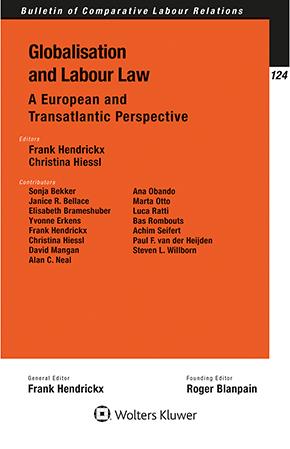
About this book:
Globalisation and Labour Law is a deeply engaged volume, in which fifteen leading scholars from nine countries explore the transformative forces reshaping labour law and regulation. They examine how European and North American legal systems respond to global value chains, digitalisation, regional labour markets, and a shifting geopolitical landscape. In a world where a globalised economy and technological change disrupt established modes of production and employment, the foundational promises of labour law are increasingly tested. While revisiting core commitments of labour law to fairness, personal autonomy, and collective representation, the chapters highlight tensions between local regulation and global forces, innovation in rights discourses, and change versus tradition.
What’s in this book:
Based on the academic contributions of the Fourth Conference in Commemoration of Roger Blanpain, held at KU Leuven in November 2025, this book engages with the future of work by asking how labour law can remain both responsive and principled in the face of global transformations. Approaching the complex questions that arise as interlocking issues, the contributors collectively address the following and more:
How this will help you:
The volume presents a rich constellation of contributions that collectively map the evolving architecture of labour law; the authors do not merely analyse; they question and interrogate. The book will prove an essential resource for scholars, practitioners, and policymakers seeking to understand and critically engage with the evolving architecture of labour law in a globalised and digital world.
Notes on Contributors
Introduction
Frank Hendrickx & Christina Hiessl
PART I
Strategic Views and Trends
CHAPTER 1
Labor Law During Trump II: The Role of Legal Structure
Steven L. Willborn
CHAPTER 2
From Unemployment to Labour Shortages: The EU Social Model and Well-Functioning Labour Markets
Sonja Bekker
PART II
Global Value Chains, International Trade and Labour Standards
CHAPTER 3
The Architecture of Global Value Chain Labour Governance
Bas Rombouts
CHAPTER 4
Global Value Chains and Labour Standards in EU Perspective
Yvonne Erkens
CHAPTER 5
The EU’s Approach to the Labour-Trade Linkage
Ana Obando & Christina Hiessl
CHAPTER 6
The USMCA: Enforcing Labour Rights in Trade Agreements
Janice R. Bellace
PART III
Collective Dimension of Digitalisation and Globalisation
CHAPTER 7
Collective Representation and the Digital Workplace
Elisabeth Brameshuber
CHAPTER 8
Worker Representatives and Their Role in the Context of Human Rights Due Diligences in Global Supply Chains
Achim Seifert
CHAPTER 9
The Right to Strike in International Perspective: From Industrial Action to a Human Right in Action
Paul F. van der Heijden
PART IV
Values, Meanings and (New) Rights
CHAPTER 10
Towards Privacy 5.0 at Work: A Foresight Approach to Normative Change
Marta Otto
CHAPTER 11
The Right to Disconnect as an Emblem of Orthodoxy
David Mangan
CHAPTER 12
Revisiting the Privacy-Autonomy-Nexus
Frank Hendrickx
PART V
EU Developments
CHAPTER 13
Blanpain’s Dream Reloaded: The Transformative Impact of the Adequate Minimum Wages Directive
Luca Ratti
CHAPTER 14
‘Brexit’ and the Limits to ‘Conscious Uncoupling’
Alan C. Neal
 NEED HELP FINDING THE RIGHT SOLUTION?
HAVE A QUESTION?


