Product Line | Kluwer Law International |
|---|---|
ISBN-13 | 9789403518091 |
Availability | Ships in 5-7 Business Days |
Last Updated | 2025-11-05 |
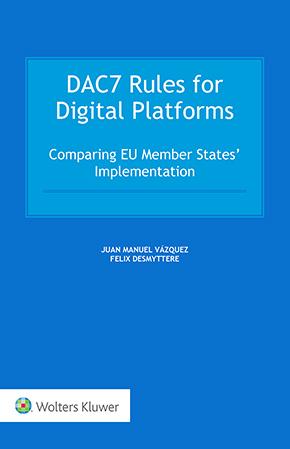
DAC7 Rules for Digital Platforms: Comparing EU Member States’ Implementation is a book that provides a comprehensive and systematic assessment of how DAC7 rules for digital platforms have been implemented by Member States in their national laws. It examines whether common or divergent approaches and interpretations of specific provisions of these rules have emerged among Member States. Council Directive 2021/514 of the European Union (DAC7) introduces, among other measures, a standardized tax reporting requirement for digital platform operators. Under this requirement, platform operators must collect, validate, keep records, and report to the tax authorities of Member States specific personal and transactional data concerning their sellers. The reported information is then automatically exchanged between tax authorities.
Why is this book relevant:
A systematic exploration and comparative analysis of the implementation of DAC7 rules is essential for the following reasons:
What’s in this book:
The issues mentioned above are covered in depth by experts who contribute national reports from 19 EU Member States, combining legal analysis with practical implementation insights. Two introductory chapters provide an overview of DAC7 rules at the EU level and provide a comparative analysis of key differences and similarities in implementation across EU Member States. Visual tools simplify the complex application of DAC7 definitions in practice and facilitate cross-jurisdictional comparison of the Directive’s implementation.
How this will help you:
The book will be invaluable to a wide range of stakeholders impacted by DAC7. In particular, it will assist businesses operating digital platform (including non-EU-based) in assessing DAC7 related risks and compliance obligations across the EU, legislators and tax authorities of EU Member States in identifying areas that require further harmonization or clarification, tax lawyers and professionals in managing legal challenges related to DAC7, businesses and individuals selling via digital platforms who may be affected by DAC7 reporting requirements, and academics and researchers interested in tax transparency frameworks and the interaction between tax law, EU law, and platform regulation.
Editors
Contributors
List of Abbreviations
Preface
CHAPTER 1
Overview of DAC7 Rules for Digital Platforms at the EU Level
Adrian Kelly
CHAPTER 2
Comparative Analysis of the Implementation of DAC7 Rules for Digital Platforms Across EU Member States
Juan Manuel Vázquez & Felix Desmyttere
CHAPTER 3
Austria
David Orzechowski-Zölzer & Martin Reiter
CHAPTER 4
Belgium
Jean-Philippe Van West
CHAPTER 5
Croatia
Irena Klemencic, Stjepan Gadžo & Ivana van der Maas
CHAPTER 6
Czech Republic
Jan Neckar & Michal Radvan
CHAPTER 7
Denmark
Jeroen Lammers
CHAPTER 8
Estonia
Marek Herm
CHAPTER 9
France
Anne-Laure Benoist, Philippe Durand & Paul-Amaury Leclerc
CHAPTER 10
Germany
Matthias Oldiges
CHAPTER 11
Greece
Katerina Perrou
CHAPTER 12
Ireland
Dara Higgins
CHAPTER 13
Italy
Daniele Majorana
CHAPTER 14
Luxembourg
Dan Zandona & Felix Desmyttere
CHAPTER 15
Malta
William Farrugia
CHAPTER 16
The Netherlands
Lu-Shen Qua
CHAPTER 17
Portugal
Álvaro Silveira de Meneses, Pedro Costa Monteiro, Rosa Freitas Soares & Miguel Marques Rocha
CHAPTER 18
Romania
Marilena Craciun (Ene)
CHAPTER 19
Slovenia
Nadja Ovcar
CHAPTER 20
Spain
Teresa Morales Gil
CHAPTER 21
Sweden
Eleonor Kristoffersson & Magnus Kristoffersson
ANNEX I
Overview of DAC7’s Implementation in Member States
ANNEX II
DAC7’s Application Flowchart
ANNEX III
Overview of Member States’ Penalties and Sanctions to Enforce DAC7
 NEED HELP FINDING THE RIGHT SOLUTION?
Call sales at 1-800-638-8437
HAVE A QUESTION?


These cookies are necessary for the website to function. They are usually set in response to actions made by you which amount to a request for services, such as setting your privacy preferences, logging in or filling in forms. You can set your browser to block or alert you about these cookies, this may have an effect on the proper functioning of (parts of) the site.
These cookies enable the website to provide enhanced functionality, user experience and personalization, and may be set by us or by third party providers whose services we have added to our pages. If you do not allow these cookies, then some or all of these services may not function properly.
These cookies support analytic services that measure and improve the performance of our site. They help us know which pages are the most and least popular and see how visitors move around the site.
These cookies may collect insights to issue personalized content and advertising on our own and other websites, and may be set through our site by third party providers. If you do not allow these cookies, you may still see basic advertising on your browser that is generic and not based on your interests.
