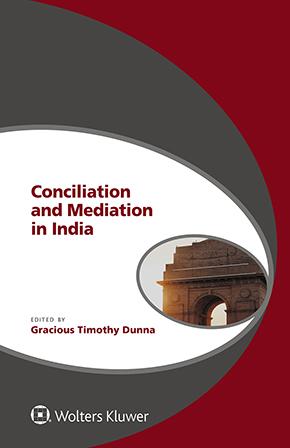
Product Line | Kluwer Law International |
|---|---|
Product SKU | 10082005-0001 |
ISBN-13 | 9789403520155 |
Availability | Ships in 5-7 Business Days |
Last Updated | 2022-02-16 |
Global Trends in Dispute Resolution Series, Volume 11
About this book:
Conciliation and Mediation in India is a comprehensive and challenging work of formidable thought-leaders in dispute resolution with global reputations. It can be said that negotiation is about what to do, whereas mediation is about how to do it—how to make sure control is in the hands of the disputants. Although mediation (as well as conciliation) is taking hold in dispute resolution worldwide, among the nations, India shows the strongest signs of interest in developing a pervasive legal mediation culture. This invaluable book describes how mediation is used, and can be used, to resolve different types of disputes in India and international cases providing a comprehensive treatment of the legal framework, principles, and procedure of mediation.
What’s in this book:
Addressing the involvement of each of the stakeholders in the process (with relevant hints on practice), exceptional contributions from a diverse group of legal practitioners, academicians, in-house counsel, and foreign lawyers examine such issues and topics as the following:
The book includes a detailed commentary on Part III of the Arbitration and Conciliation Act 1996 and the 2018 Singapore Convention on Mediation.
How this will help you:
This book takes into account where India stands at present, covering statutes, international conventions, and academic literature, thus bequeathing a broad understanding of the subject for legal practitioners, judges, arbitrators, mediators and conciliators, users, and technical experts who wish to understand it. The nature and scope of this book should appeal most to practitioners, neutrals, and academics, including students, providing them with a profitable read on mediation and conciliation in India. One of its kind, this book stands up to scrutiny and meets the expectations of many making it valuable.
Editor
Contributors
Foreword by Michael McIlwrath
Foreword by Ratan K. Singh
Preface
Acknowledgments
Introduction
Gracious Timothy Dunna
CHAPTER 1 Introduction to Mediation and Conciliation in India
Gracious Timothy Dunna
CHAPTER 2 Role and Approach of the Mediator
Jonathan Rodrigues & Joel Lee
CHAPTER 3 Mediation and Ethics
Sandeep Bhalothia & Anil Xavier
CHAPTER 4 Court-Annexed Mediation
Raj Panchamatia & Laila Ollapally
CHAPTER 5 Institutional Mediation
Shashank Garg & Tejas Karia
CHAPTER 6 Mediating Commercial Disputes
Shraddha Bhosale & Sahil Kanuga
CHAPTER 7 Mediating Company, Insolvency, and Bankruptcy Disputes
Anant Merathia
CHAPTER 8 Mediating Government Disputes
Badrinath Srinivasan & Arjun Natarajan
CHAPTER 9 Mediating Investor-State Disputes
Harshad Pathak & Pratyush Panjwani
CHAPTER 10 Mediating Family Disputes
A. J. Jawad & Nisshant Laroia
CHAPTER 11 E-Mediation
Ishana Tripathi
CHAPTER 12 Community Mediation and Citizen Empowerment
Kudrat Dev & Ajay Pandey
CHAPTER 13 Mixed-Mode Dispute Resolution
Gracious Timothy Dunna & Kabir Duggal
CHAPTER 14 Cross-Border Enforcement of International Mediated Settlement Agreements and the Singapore Convention
Gracious Timothy Dunna & Jatan Rodrigues
CHAPTER 15 Law of Conciliation
Gracious Timothy Dunna & Manisha T. Karia
CHAPTER 16 Ready, Set, Mediate: For the Mediator
Judith B. Ittig & Gracious Timothy Dunna
CHAPTER 17 Ready, Set, Mediate: For the Advocate
Judith B. Ittig & Gracious Timothy Dunna
 NEED HELP FINDING THE RIGHT SOLUTION?
Call sales at 1-800-638-8437
HAVE A QUESTION?


These cookies are necessary for the website to function. They are usually set in response to actions made by you which amount to a request for services, such as setting your privacy preferences, logging in or filling in forms. You can set your browser to block or alert you about these cookies, this may have an effect on the proper functioning of (parts of) the site.
These cookies enable the website to provide enhanced functionality, user experience and personalization, and may be set by us or by third party providers whose services we have added to our pages. If you do not allow these cookies, then some or all of these services may not function properly.
These cookies support analytic services that measure and improve the performance of our site. They help us know which pages are the most and least popular and see how visitors move around the site.
These cookies may collect insights to issue personalized content and advertising on our own and other websites, and may be set through our site by third party providers. If you do not allow these cookies, you may still see basic advertising on your browser that is generic and not based on your interests.
