Product Line | Kluwer Law International |
|---|---|
Product SKU | 10058890-0001 |
ISBN-13 | 9789041149848 |
Availability | Ships in 3-5 Business Days |
Last Updated | 2014-01-2 |
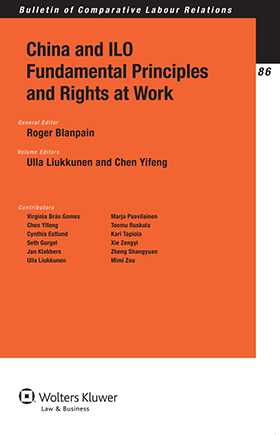
Bulletin of Comparative Labour Relations Volume 86
Although China is not new to labour law – it was among the founders of the International Labour Organisation (ILO) in 1919 – labour conditions in China today are the subject of concern to observers both inside China and in the international community. In response, China has devoted much attention recently to reforming its labour law system, a process driven by a political reorientation towards labour protection in the context of economic globalization. However, labour disputes and labour unrest continue to proliferate.
Using as its starting point an international research seminar held at Helsinki University in January 2013, this volume gathers a remarkable array of academic perspectives on China and its legal system by scholars from China, the United States, and Europe into a stimulating and unique combination of commentary and analysis of the challenges relating to implementation of fundamental labour rights as spelled out in the landmark 1998 ILO Declaration on Fundamental Principles and Rights at Work in the Chinese setting. Importantly, the analysis fully takes into account action in relation to the promotion of labour rights by not only the Chinese government but local governmental authorities, trade unions, enterprises, and other actors. Each author focuses on a different aspect of how these fundamental labour rights operate in the Chinese legal environment and the kinds of obstacles met in their protection. Among the issues that arise are the following:
Notes on Contributors.
Preface.
Chapter 1. Introduction; U. Liukkunen, Chen Yifeng.
Chapter 2. The ILO Declaration on Fundamental Principles and Rights at Work and Its Implementation in China; K. Tapiola.
Chapter 3. The International Labour Organisation and Labour Governance in China 1919–1949; Chen Yifeng.
Chapter 4. The Evolution of Collective Labour Law with ‘Chinese Characteristics’? ‘Crossing the River by Feeling the Stones?’ M. Zou.
Chapter 5. Collective Bargaining in China: Laws, Problems, and Prospects; Zheng Shangyuan.
Chapter 6. Will Labour Unrest Lead to More Democratic Trade Unions in China? C. Estlund, S. Gurgel.
Chapter 7. The Right to Work and Rights at Work: Gender Implications; V. Brás Gomes .
Chapter 8. Employment Discrimination Legislation and Practice in China in the Context of ILO Discrimination Convention No. 111: Successes, Challenges and Dynamics of Change; M. Paavilainen.
Chapter 9. New Developments in Anti-discrimination in the Workplace in China: Law and Practice; Xie Zengyi .
Chapter 10. Transnational Labour Law and Fundamental Labour Rights – Making Chinese Workers Matter? U. Liukkunen. .
Chapter 11. Marginalized International Organizations: Three Hypotheses Concerning the ILO; J. Klabbers.
Chapter 12. Afterword: Globalization, Rights, and Work in the Chinese Transformation; T. Ruskola.
 NEED HELP FINDING THE RIGHT SOLUTION?
Call sales at 1-800-638-8437
HAVE A QUESTION?


These cookies are necessary for the website to function. They are usually set in response to actions made by you which amount to a request for services, such as setting your privacy preferences, logging in or filling in forms. You can set your browser to block or alert you about these cookies, this may have an effect on the proper functioning of (parts of) the site.
These cookies enable the website to provide enhanced functionality, user experience and personalization, and may be set by us or by third party providers whose services we have added to our pages. If you do not allow these cookies, then some or all of these services may not function properly.
These cookies support analytic services that measure and improve the performance of our site. They help us know which pages are the most and least popular and see how visitors move around the site.
These cookies may collect insights to issue personalized content and advertising on our own and other websites, and may be set through our site by third party providers. If you do not allow these cookies, you may still see basic advertising on your browser that is generic and not based on your interests.
